English
 Español
 tiếng việt
 русский
Excellent abrasion resistance for demanding mechanical environments.
Good low-temperature flexibility down to –30 °C.
High tensile strength and elongation at break for dynamic applications.
Good resistance to oils, greases, and many common industrial fluids.
Processable via extrusion, injection molding, and blow molding with stable melt viscosity.
Industrial hoses and tubing for hydraulic and pneumatic systems.
Protective covers and wear sleeves for machinery components.
Mobile equipment seals and gaskets requiring resilience and fatigue resistance.
Conveyor belting components in material handling systems.
Specialty footwear soles for work boots requiring durability and traction.
| Chemical Type | Thermoplastic Polyurethane (TPU), polyester-based |
| Product Form | Pellets |
| Appearance | Off-white to light tan, free-flowing pellets |
| Shore A Hardness | 65 ± 3 |
| Tensile Strength (ASTM D412) | ≥ 32 MPa |
| Elongation at Break (ASTM D412) | ≥ 500 % |
| Melt Flow Index (230 °C/2.16 kg, ASTM D1238) | 10–14 g/10 min |
| Density (ASTM D792) | 1.18–1.20 g/cm³ |
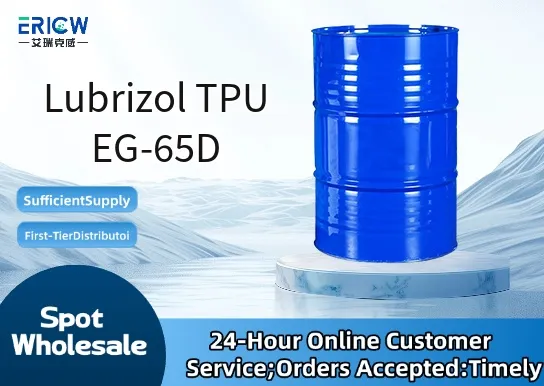
Q1: What is Lubrizol TPU EG-65D, and how does it differ from standard thermoplastic polyurethane (TPU) resins?
A: Lubrizol TPU EG-65D is a specialized ethylene glycol–modified thermoplastic polyurethane elastomer designed to enhance melt processability and surface compatibility in demanding compound formulations. Unlike conventional TPUs, it features tailored chain-end functionality that improves dispersion in polar polymer matrices and supports better interfacial adhesion in multi-material systems.
Q2: In which types of polymer systems is TPU EG-65D most commonly used as a compatibilizer or impact modifier?
A: It is frequently employed in engineering thermoplastic blends—particularly with polyesters (e.g., PET, PBT), polycarbonate (PC), and polyamide (PA)—to improve toughness, reduce phase separation, and enhance mechanical retention after thermal aging or humidity exposure. Its polarity profile makes it especially effective in polar-rich systems where conventional non-polar modifiers show limited efficacy.
Q3: Is TPU EG-65D suitable for applications requiring regulatory compliance for indirect food contact or medical device components?
A: While TPU EG-65D is manufactured under strict quality controls and is widely used in high-integrity industrial applications, formal regulatory clearance (e.g., FDA, EU food contact, or ISO 10993) must be verified on a case-by-case basis through Lubrizol’s regulatory support team and validated testing of the final compounded formulation—not the raw additive alone.
Q4: How should TPU EG-65D be processed during compounding or extrusion?
A: It processes readily using standard twin-screw extrusion equipment. Recommended drying is at 70–80 °C for 2–4 hours prior to processing to minimize moisture-induced degradation. Typical residence time and shear profiles should avoid prolonged exposure to temperatures above 230 °C to preserve functional end-group integrity and performance consistency.
Q5: What are key handling and storage recommendations for TPU EG-65D?
A: Store in original sealed packaging in a cool, dry environment (<25 °C, <50% RH). Once opened, reseal tightly and use within 72 hours if ambient conditions exceed recommended humidity levels. Prolonged exposure to humid air may lead to surface tackiness or reduced dispersion efficiency during compounding.
Contact With Us:
E-mail: wangxingqiang@ericwchem.com
Have a Questions? Call Us:
Add:
Building A1, Jiete Industrial Park, Huangpu District, Guangzhou City, Guangdong Province, China