English
 Español
 tiếng việt
 русский
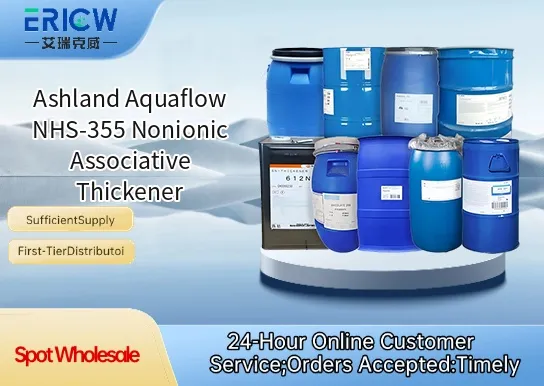
Delivers excellent rheology control and high-shear viscosity stability in waterborne systems.
Provides outstanding sag resistance and leveling performance in architectural and industrial coatings.
Offers low VOC compatibility and minimal impact on gloss and clarity in clear and pigmented formulations.
Enables efficient thickening at low use levels with robust electrolyte tolerance.
Exhibits excellent freeze-thaw stability and long-term storage performance in latex-based systems.
Architectural interior and exterior flat and low-sheen paints.
Industrial maintenance coatings for metal and concrete substrates.
Waterborne wood stains and varnishes.
Adhesives and sealants requiring nonionic, associative thickening.
Printing inks and functional aqueous dispersions.
| Chemical Type | Nonionic associative polyurethane thickener |
| Product Form | Aqueous dispersion |
| Appearance | Opaque white to off-white liquid |
| pH (as supplied) | 7.0–8.5 |
| Active Content (wt%) | 30–32% |
| Viscosity (Brookfield, 25°C, spindle #3, 20 rpm) | 1,500–4,000 cP |
| Primary Applications | Architectural coatings, industrial coatings, adhesives |
| Key Features | Rheology modifier, associative thickener, nonionic, low-VOC compatible |
Q1: What types of formulations is Aquaflow NHS-355 best suited for?
A: Aquaflow NHS-355 is specifically designed for water-based, low-VOC, and high-solids architectural coatings—including interior and exterior flat to satin finishes—as well as industrial maintenance paints and some specialty inks where nonionic character and associative thickening are required.
Q2: How does NHS-355 differ from ionic thickeners like CMC or HEC?
A: Unlike ionic cellulose ethers, NHS-355 functions via hydrophobic association in aqueous systems, delivering superior shear-thinning behavior, enhanced spatter resistance, and improved sag resistance—without sensitivity to electrolytes or pH fluctuations typical of ionic thickeners.
Q3: Can NHS-355 be used in combination with other rheology modifiers?
A: Yes—NHS-355 is commonly blended with cellulosic thickeners (e.g., HEC) or inorganic thickeners (e.g., bentonite) to achieve balanced flow, leveling, and anti-settling performance. Compatibility testing is recommended to confirm synergistic effects and avoid antagonism in specific formulations.
Q4: What is the recommended addition method for optimal performance?
A: For best results, NHS-355 should be added during the let-down stage under moderate agitation. Pre-dilution with water or co-solvent (e.g., propylene glycol) is advised to ensure uniform dispersion and prevent localized gel formation.
Q5: Is NHS-355 compatible with biocides commonly used in paint formulations?
A: NHS-355 demonstrates good compatibility with a broad range of isothiazolinone and formaldehyde-releasing biocides. However, formulation-specific stability testing is recommended, particularly when using high concentrations of oxidizing or highly reactive preservatives.
Contact With Us:
E-mail: wangxingqiang@ericwchem.com
Have a Questions? Call Us:
Add:
Building A1, Jiete Industrial Park, Huangpu District, Guangzhou City, Guangdong Province, China