English
 Español
 tiếng việt
 русский
High thermal stability up to 800 °C, suitable for high-temperature ceramic and enamel applications.
Excellent lightfastness and weather resistance, maintaining color integrity under prolonged UV exposure.
Chemically inert in acidic and alkaline environments, ensuring compatibility with diverse binder systems.
Fine particle size distribution (D50 ≈ 1.2–1.8 μm) enabling smooth dispersion and high chromatic strength.
Non-toxic and heavy-metal-free formulation compliant with global regulatory standards including RoHS and REACH.
Ceramic glazes and frits for tableware, sanitaryware, and architectural tiles.
High-performance enamel coatings for domestic appliances and industrial metal substrates.
Colorants in refractory materials and heat-resistant coatings for furnace linings.
Pigmentation of low-VOC architectural and industrial coatings requiring long-term durability.
Functional coloring agent in specialty glass formulations and borosilicate glass products.
| Chemical Type | Mixed-Metal Oxide (Spinel-based) |
| Product Form | Free-flowing dry powder |
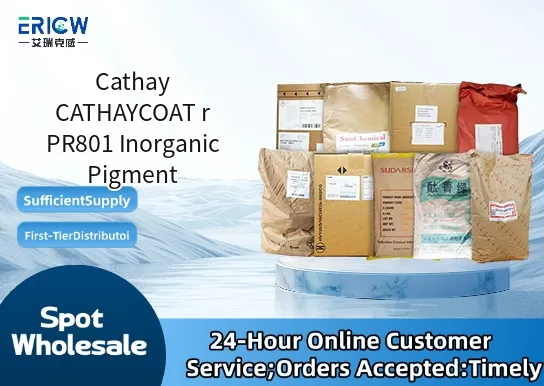
| Appearance | Uniform reddish-brown granular powder |
| Primary Applications | Ceramics, enamels, refractories, architectural coatings |
| Key Features | Thermal stability, UV resistance, chemical inertness, low oil absorption |
| Benefits | Consistent batch-to-batch color, easy dispersion, no blooming or migration |
| pH (10% aqueous slurry) | 6.5–7.5 |
| LOI (1000 °C, 1 hr) | < 0.5 wt% |
Q1: What is the primary chemical composition of CATHAYCOAT® PR801?
A: CATHAYCOAT® PR801 is a high-performance inorganic pigment based on a modified mixed-metal oxide system, engineered for exceptional thermal stability and UV resistance. Its precise crystalline structure is proprietary to Cathay, optimized for consistent color development and minimal interaction with binder matrices.
Q2: Is PR801 suitable for high-temperature coating applications, such as coil coatings or powder coatings?
A: Yes — PR801 is specifically formulated for demanding thermal processing environments. It maintains color integrity and dispersion stability during curing cycles up to 250°C, making it well-suited for coil coatings, architectural powder coatings, and other industrial finishes requiring prolonged heat exposure.
Q3: How does PR801 perform in acidic or alkaline environments commonly encountered in industrial coatings?
A: PR801 exhibits excellent chemical inertness across a broad pH range. It demonstrates strong resistance to hydrolysis and ion exchange in both mildly acidic and alkaline formulations, supporting long-term stability in water-based and solvent-based systems without significant color shift or agglomeration.
Q4: Can PR801 be used in food-contact compliant coatings?
A: While PR801 itself is an inorganic pigment with inherently low leachability, final regulatory compliance for food-contact applications depends on the complete coating formulation, including binders, additives, and processing conditions. Customers must validate suitability through full-system testing per applicable regional requirements.
Q5: What is the recommended dosage range for optimal color strength and dispersion efficiency?
A: PR801 is highly efficient and typically used at low concentrations. Dosage generally ranges from 0.1% to 2% by weight relative to total solids, depending on the desired opacity, hue intensity, and base formulation viscosity. Optimal loading should be determined via lab-scale dispersion trials and rheological evaluation.
Contact With Us:
E-mail: wangxingqiang@ericwchem.com
Have a Questions? Call Us:
Add:
Building A1, Jiete Industrial Park, Huangpu District, Guangzhou City, Guangdong Province, China