English
 Español
 tiếng việt
 русский
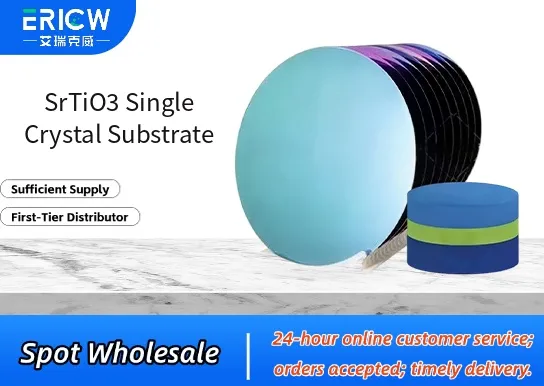
Highly stable perovskite crystal structure with excellent lattice match for epitaxial growth of oxide thin films.
Ultra-low defect density and surface roughness (<0.2 nm RMS) after chemical-mechanical polishing (CMP).
Wide bandgap (~3.2 eV) enabling high dielectric strength and low optical absorption in visible–NIR range.
Excellent thermal stability up to 1300 °C in oxidizing atmospheres without phase decomposition.
Controlled off-cut orientation (e.g., 0.1°–1.0° toward [100] or [110]) for step-flow epitaxy and domain engineering.
Heteroepitaxial growth of high-temperature superconductors (e.g., YBCO, LSCO) for quantum devices and SQUIDs.
Platform for complex oxide heterostructures in spintronics, ferroelectric tunnel junctions, and memristive neuromorphic devices.
Substrate for atomic-layer deposition (ALD) and pulsed laser deposition (PLD) of functional oxide thin films (e.g., LaAlO₃, NiO, CoFe₂O₄).
Reference standard in X-ray diffraction (XRD), Raman spectroscopy, and surface science calibration studies.
Base material for tunable microwave dielectrics and high-K gate dielectrics in advanced microelectronics research.
| Chemical Type | Strontium Titanate (SrTiO₃), single-crystal perovskite oxide |
| Product Form | Polished wafers (standard diameters: 10 mm, 15 mm, 25 mm; thickness: 0.5 mm ±0.05 mm) |
| Crystal Orientation | (001) surface, ±0.1° miscut tolerance; optional (110) or (111) orientations available |
| Surface Finish | Double-side polished, epi-ready; Ra < 0.15 nm, no scratches or pits (per SEM/AFM verification) |
| Melting Point | ~2080 °C (decomposes before full melting under ambient pressure) |
| Primary Applications | Epitaxial thin-film synthesis, fundamental condensed matter research, device prototyping |
| Key Features | High purity (>99.99% trace metals), stoichiometric composition, low twin density, low dislocation density (<1 × 10⁴ cm⁻²) |
| Regulatory Compliance | RoHS-compliant; no REACH SVHC substances above threshold; certified non-hazardous for transport (UN3077) |
| Common Compatible Systems | Suitability |
| Pulsed Laser Deposition (PLD) systems (e.g., Newport, TSST, K.J. Lesker) | Highly Recommended – Optimized for oxygen-rich chamber environments and high-temperature substrate heating (≤800 °C) |
| Molecular Beam Epitaxy (MBE) with oxide effusion cells (e.g., Veeco, Riber) | Highly Recommended – Compatible with in-situ RHEED monitoring and ultra-high vacuum (UHV <1×10⁻¹⁰ Torr) conditions |
| Atomic Layer Deposition (ALD) platforms (e.g., Beneq, Picosun, Oxford Instruments) | Recommended – Requires pre-treatment (O₂ plasma or annealing) for optimal nucleation of Al₂O₃, HfO₂, etc. |
| Scanning Probe Microscopy (SPM) & AFM systems | Suitable – Atomically flat surface enables high-resolution topography and piezoresponse imaging without additional cleaning |
Q1: What is the CAS Registry Number for SrTiO₃?
A: The CAS Registry Number for strontium titanate is 12060-58-1.
Q2: Is SrTiO₃ subject to leaching or ion migration when used in aqueous or electrochemical environments?
A: SrTiO₃ exhibits negligible dissolution under neutral pH and ambient temperature; however, prolonged exposure to acidic (pH <3) or strongly alkaline (pH >12) solutions may cause slow Sr²⁺ leaching. Not recommended for long-term immersion applications without protective capping layers.
Q3: How does SrTiO₃ compare to MgO or LaAlO₃ substrates for oxide heteroepitaxy?
A: SrTiO₃ offers superior lattice matching for many perovskite oxides (e.g., ~0.1% mismatch with YBCO), higher thermal stability than MgO, and lower interfacial reactivity than LaAlO₃—making it preferred for multilayer oxide stacks requiring atomic precision and interface integrity.
Q4: Does your SrTiO₃ substrate carry any regulatory certifications (e.g., ISO 9001, REACH, RoHS)?
A: All batches are manufactured under ISO 9001-certified quality management systems. Each lot includes a Certificate of Analysis (CoA) confirming RoHS compliance and absence of REACH SVHC substances above 0.1 wt%. Full regulatory documentation is available upon request.
Contact With Us:
E-mail: wangxingqiang@ericwchem.com
Have a Questions? Call Us:
Add:
Building A1, Jiete Industrial Park, Huangpu District, Guangzhou City, Guangdong Province, China