English
 Español
 tiếng việt
 русский
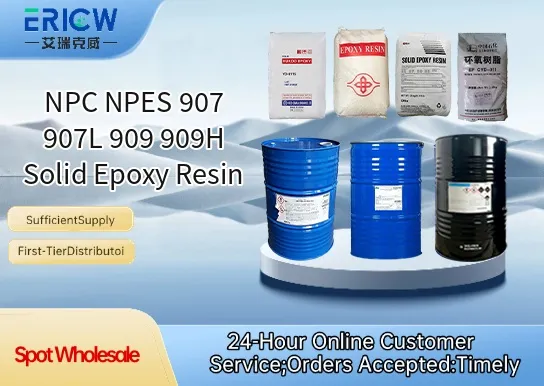
High purity solid bisphenol-A based epoxy resin with consistent molecular weight distribution.
Excellent thermal stability and low volatile organic compound (VOC) content for safer processing.
Superior adhesion to metals, composites, and cured polymer substrates.
Optimized melt viscosity for efficient solvent-free coating, casting, and adhesive formulation.
Compatible with standard amine, anhydride, and phenolic curing agents across industrial systems.
High-performance powder coatings for automotive and appliance components.
Structural adhesives in aerospace and wind turbine blade assembly.
Electrical encapsulation and insulating potting compounds for power electronics.
Prepreg matrix resins for carbon fiber and glass fiber reinforced laminates.
High-gloss decorative flooring and industrial terrazzo systems.
| Chemical Type | Bisphenol-A diglycidyl ether (DGEBA) epoxy resin |
| Product Form | Pale yellow to off-white solid flakes or pellets |
| Appearance | Homogeneous solid, free from visible impurities |
| Epoxy Equivalent Weight (EEW) | 460–510 g/eq (varies by grade: 907, 907L, 909, 909H) |
| Melt Viscosity (150°C) | 8,000–15,000 cP (grade-dependent) |
| Softening Point | 75–95°C (determined per ASTM E28) |
| Chlorine Content | ≤ 1,200 ppm (total chlorine) |
| Key Features | Low color, high reactivity, batch-to-batch consistency |
Q1: What are the key differences between NPES 907, 907L, 909, and 909H grades?
A: These grades differ primarily in molecular weight distribution, softening point, and reactivity profile—designed to support distinct processing conditions and end-use performance requirements. For example, 907L offers enhanced flow characteristics for thin-film applications, while 909H provides higher thermal stability for demanding curing cycles.
Q2: How should these solid epoxy resins be handled and stored to maintain stability?
A: Store in original sealed containers in a cool, dry, well-ventilated area away from direct sunlight and sources of heat or ignition. Avoid prolonged exposure to high humidity, as moisture absorption may affect handling properties and subsequent dispersion behavior.
Q3: Are these resins compatible with common epoxy hardeners and modifiers?
A: Yes—they are fully compatible with standard amine-based, anhydride, and phenolic hardeners, as well as reactive diluents and toughening agents used in industrial epoxy systems. Compatibility and cure kinetics should be verified experimentally for each specific formulation.
Contact With Us:
E-mail: wangxingqiang@ericwchem.com
Have a Questions? Call Us:
Add:
Building A1, Jiete Industrial Park, Huangpu District, Guangzhou City, Guangdong Province, China