English
 Español
 tiếng việt
 русский
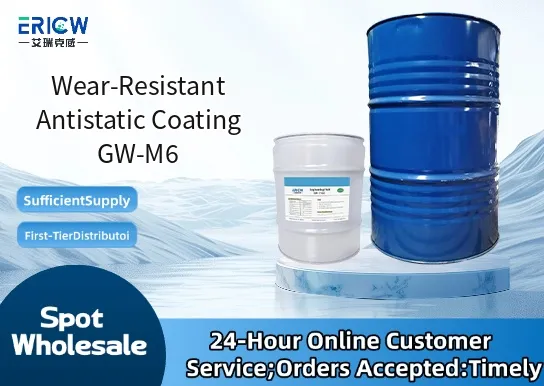
Exceptional abrasion resistance with >10× improvement in Taber wear index vs. standard antistatic coatings.
Stable surface resistivity of 10⁶–10⁹ Ω/sq across 20–80% RH and 15–40°C operating range.
Non-migrating, covalently bound antistatic functionality ensures long-term performance without blooming or leaching.
Low-temperature cure compatible (120–140°C, 20–30 min), suitable for heat-sensitive substrates.
Halogen-free formulation meeting IPC-4101D and RoHS 3 (2015/863/EU) requirements.
Electrostatic discharge (ESD)-sensitive electronics housings and enclosures.
Automotive interior trim components requiring both wear resistance and static control (e.g., center consoles, gear shifters).
Medical device casings where particle generation and static attraction must be minimized.
Industrial control panels and HMI surfaces exposed to frequent cleaning and mechanical contact.
High-use consumer electronics accessories (e.g., VR headset frames, portable diagnostic tool housings).
| Chemical Type | Modified acrylic-polyurethane hybrid resin with grafted quaternary ammonium antistatic moiety |
| Product Form | Solvent-based liquid (toluene/xylene-free; uses ethyl acetate and PGMEA) |
| Appearance | Clear, slightly viscous liquid; slight amber tint (APHA < 50) |
| Density (25°C) | 1.02–1.05 g/cm³ |
| Solids Content (wt%) | 38–42% |
| Primary Applications | Topcoat for rigid thermoplastics (PC, ABS, PC/ABS, PBT) and coated metals |
| Key Features | Wear-resistant, antistatic, low-VOC, non-yellowing, UV-stable |
| Regulatory Compliance | RoHS 3 compliant; REACH SVHC free; ISO 10993-5 (cytotoxicity) passed; no listed CAS for intentional nanomaterials |
| Common Compatible Systems | Suitability |
| GW-Primer P12 (epoxy-acrylic adhesion promoter) | Highly Recommended – Optimized for enhanced intercoat adhesion and ESD stability on ABS/PC |
| GW-Topcoat T7 (matte clear protective overcoat) | Recommended – Maintains antistatic performance when applied at ≤15 μm DFT |
| Standard polyurethane spray basecoats (non-silicone) | Suitable – Requires 24-hr flash-off before GW-M6 application; avoid high-Tg formulations >110°C |
| UV-curable acrylic undercoats | Suitable – Must be fully cured (≥800 mJ/cm²) and de-ionized prior to coating |
Q1: What is the CAS Registry Number for GW-M6?
A: GW-M6 is a proprietary multi-component formulation; individual reactants are disclosed under confidential CAS numbers per customer NDA. The final cured film has no CAS assignment as it is a crosslinked network.
Q2: What is the recommended dry film thickness (DFT) for optimal antistatic and wear performance?
A: Target 18–22 μm DFT. Below 15 μm, surface resistivity rises above 10⁹ Ω/sq; above 25 μm, flexibility and adhesion may decrease under thermal cycling.
Q3: How does GW-M6 compare to conventional carbon-black–based antistatic coatings in terms of appearance and processing?
A: Unlike carbon-black systems, GW-M6 delivers transparent, colorless finish with no haze or gray undertone, supports high-gloss aesthetics, and avoids nozzle clogging during spray application due to absence of particulates.
Q4: Is GW-M6 subject to extractable or migratable antistatic agent concerns under ISO 10993 or USP Class VI testing?
A: No. The antistatic functionality is chemically grafted into the polymer backbone; extraction studies (24h in saline, ethanol, and isooctane at 50°C) show <0.05% mass loss and no detectable ionic leachables by IC-MS.
Contact With Us:
E-mail: wangxingqiang@ericwchem.com
Have a Questions? Call Us:
Add:
Building A1, Jiete Industrial Park, Huangpu District, Guangzhou City, Guangdong Province, China