English
 Español
 tiếng việt
 русский
Excellent abrasion resistance for extended service life in demanding mechanical environments.
Outstanding flexibility and elasticity across a wide temperature range (−40 °C to 80 °C).
Good oil, grease, and hydrocarbon resistance suitable for industrial and automotive exposure.
High transparency and clarity ideal for aesthetic-sensitive applications requiring optical quality.
Easy processability via extrusion, injection molding, and calendering without plasticizer addition.
Transparent protective films for electronics and touchscreens.
Flexible tubing and fluid handling components in medical devices.
High-clarity gaskets and seals for optical enclosures and lighting systems.
Soft-touch overmolding for consumer electronics housings and wearable device components.
Specialty cables and jacketing requiring UV stability and low-temperature flexibility.
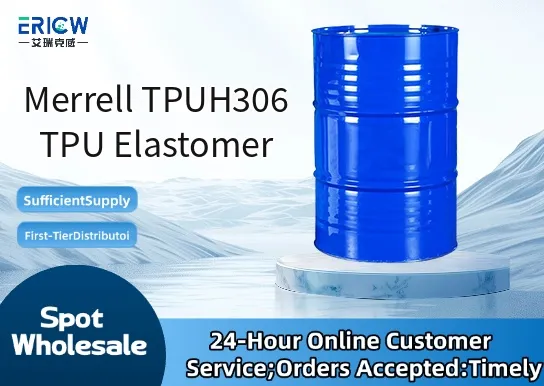
| Chemical Type | Aliphatic polyester-based thermoplastic polyurethane (TPU) |
| Product Form | Pellets |
| Appearance | Transparent, translucent granules with uniform size and low dust generation |
| Shore A Hardness | 85 ± 3 |
| Melt Flow Index (190 °C/2.16 kg) | 12–16 g/10 min |
| Density | 1.18–1.20 g/cm³ |
| Key Features | UV-stabilized, hydrolysis-resistant, non-yellowing |
| Primary Applications | Optical films, medical tubing, transparent seals, soft-touch overmold |
Q1: What is the primary processing method recommended for Merrell TPUH306?
A: Merrell TPUH306 is specifically formulated for melt-processing techniques including extrusion, injection molding, and calendering. It exhibits excellent melt stability and low viscosity at typical processing temperatures, enabling smooth flow and good surface finish in finished parts.
Q2: Is Merrell TPUH306 suitable for applications requiring hydrolysis resistance?
A: Yes — as an aliphatic polyester-based TPU, Merrell TPUH306 offers significantly improved resistance to hydrolytic degradation compared to standard polyester TPUs, particularly under warm, humid conditions. Long-term performance remains robust when properly dried prior to processing and protected from prolonged exposure to high-moisture environments.
Q3: Can Merrell TPUH306 be blended with other polymers?
A: Merrell TPUH306 demonstrates good compatibility with several engineering thermoplastics such as PC, ABS, and certain grades of polyolefins — especially when used as a toughening modifier or impact enhancer. Compatibility should be verified through preliminary melt blending trials and morphology assessment, as phase behavior depends on formulation specifics and processing parameters.
Q4: How should Merrell TPUH306 be dried before processing?
A: Prior to melt processing, Merrell TPUH306 must be thoroughly dried to minimize moisture-induced degradation. A standard recommendation is drying at 80–90 °C for 3–4 hours using a desiccant dryer. Residual moisture content should be maintained below 0.05% for optimal melt integrity and mechanical property retention.
Contact With Us:
E-mail: wangxingqiang@ericwchem.com
Have a Questions? Call Us:
Add:
Building A1, Jiete Industrial Park, Huangpu District, Guangzhou City, Guangdong Province, China