English
 Español
 tiếng việt
 русский
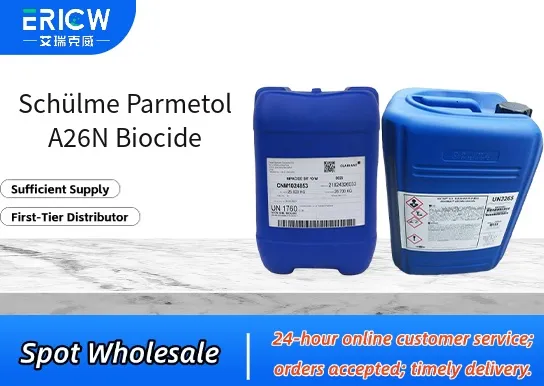
Highly effective broad-spectrum biocide against bacteria, fungi, and algae.
Stable in acidic to neutral pH ranges (pH 3–7.5), ensuring compatibility with common industrial formulations.
Low volatility and excellent water solubility for uniform distribution in aqueous systems.
Non-oxidizing chemistry, minimizing corrosion risk to metal components and elastomers.
Compatible with anionic, nonionic, and cationic surfactants and common polymer thickeners.
Preservation of water-based paints and coatings during storage and application.
Microbial control in industrial process water circuits, including cooling towers and closed-loop systems.
Protection of adhesives, sealants, and caulking compounds against spoilage.
Stabilization of construction chemicals such as grouts, mortars, and tile adhesives.
Preservation of metalworking fluids and hydraulic emulsions.
| Chemical Type | Isothiazolinone-based biocide (active ingredients: 2-methylisothiazolin-3-one and 5-chloro-2-methylisothiazolin-3-one) |
| Product Form | Aqueous solution |
| Appearance | Clear, colorless to pale yellow liquid |
| pH (1% aqueous solution) | 2.5–4.0 |
| Density (20 °C) | 1.02–1.06 g/cm³ |
| Solubility | Completely miscible with water in all proportions |
| Storage Stability | ≥24 months at 5–25 °C in original unopened container |
| Primary Applications | Preservative for water-based industrial formulations |
Q1: What is the primary mode of action of Schülme Parmetol A26N Biocide?
A: Schülme Parmetol A26N Biocide functions primarily through membrane disruption and interference with essential microbial metabolic processes, delivering broad-spectrum efficacy against bacteria, yeasts, and molds in water-based industrial formulations.
Q2: In which types of formulations is Parmetol A26N typically used?
A: It is commonly incorporated into water-miscible metalworking fluids, industrial cleaning agents, latex paints, adhesives, and other aqueous polymer systems where long-term microbiological stability is required during storage and use.
Q3: How stable is Parmetol A26N under varying pH and temperature conditions?
A: Parmetol A26N demonstrates good stability across a typical industrial pH range of 5–9 and retains effectiveness under moderate thermal stress encountered during formulation processing and ambient storage conditions.
Q4: Is Parmetol A26N compatible with common surfactants and thickeners used in industrial formulations?
A: Yes — it exhibits favorable compatibility with nonionic and anionic surfactants, cellulose ethers, associative thickeners, and many common emulsifiers, supporting its integration into complex, multi-component systems without phase separation or performance loss.
Contact With Us:
E-mail: wangxingqiang@ericwchem.com
Have a Questions? Call Us:
Add:
Building A1, Jiete Industrial Park, Huangpu District, Guangzhou City, Guangdong Province, China