English
 Español
 tiếng việt
 русский
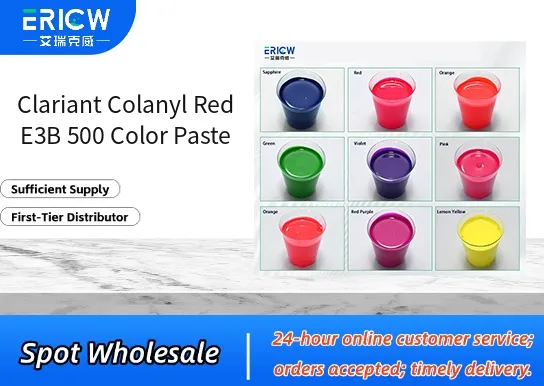
High chroma red shade with excellent batch-to-batch color consistency.
Optimized for dispersion in water-based and solvent-based acrylic, vinyl, and alkyd systems.
Good thermal stability up to 180 °C, suitable for moderate-temperature processing.
Low volatile organic compound (VOC) content, supporting sustainable formulation goals.
Compatible with common co-pigments and additives used in industrial coatings and inks.
Architectural and industrial waterborne coatings.
Automotive refinish coatings (basecoat and primer-surfacer).
Plastic masterbatches for interior automotive components.
General-purpose printing inks for packaging substrates.
Wood finishes and furniture coatings requiring lightfast red tones.
| Chemical Type | Organic pigment dispersion (Red 170 derivative) |
| Product Form | Concentrated liquid color paste |
| Appearance | Viscous, homogeneous red paste |
| Primary Applications | Coatings, inks, and plastic coloration |
| Key Features | Good dispersibility, high tinctorial strength, low dusting risk |
| Benefits | Reduced formulation time, improved color reproducibility, lower handling hazard vs. dry pigments |
| Storage Conditions | Store at 5–30 °C; protect from freezing and direct sunlight |
| Shelf Life | 24 months from date of manufacture when stored properly |
Q1: What types of polymer systems is Colanyl Red E3B 500 compatible with?
A: Colanyl Red E3B 500 is formulated for use in polyolefins—particularly polypropylene (PP) and polyethylene (PE)—and shows good compatibility in thermoplastic elastomers (TPEs) and certain engineering plastics. It is not recommended for high-temperature engineering resins like PEEK or PSU without prior compatibility testing.
Q2: How should this color paste be incorporated into the base polymer?
A: The paste is typically introduced via masterbatch dilution or direct gravimetric dosing into the extruder feed throat or side feeder. For optimal dispersion, ensure adequate melt mixing time and shear history—especially in high-output compounding lines. Pre-blending with carrier resin before extrusion may improve homogeneity in sensitive formulations.
Q3: Does Colanyl Red E3B 500 meet regulatory requirements for food-contact applications?
A: This grade is designed to comply with major global food-contact regulations for polyolefins, including FDA 21 CFR §178.3297 and EU Framework Regulation (EC) No 1935/2004. Final compliance depends on the full formulation, processing conditions, and end-use scenario—so users must conduct their own verification per applicable jurisdiction and application.
Q4: What is the typical dosage range for achieving standard red shades in PP injection molding?
A: Dosage depends on desired shade intensity and substrate opacity, but typical usage ranges from 0.1% to 2% by weight in polypropylene. Lighter tints usually fall below 0.5%, while deeper, more saturated reds may require up to 1.5–2.0%, subject to rheological and thermal stability considerations.
Q5: How does heat stability affect performance during processing?
A: Colanyl Red E3B 500 offers good thermal stability suitable for standard polyolefin processing temperatures (up to approximately 260 °C). Prolonged residence times above 240 °C or repeated reprocessing may lead to subtle hue shifts; therefore, minimizing thermal stress is recommended for critical color consistency.
Contact With Us:
E-mail: wangxingqiang@ericwchem.com
Have a Questions? Call Us:
Add:
Building A1, Jiete Industrial Park, Huangpu District, Guangzhou City, Guangdong Province, China