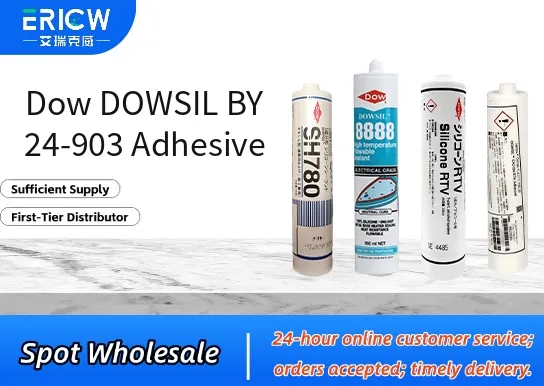
Features Of Dow DOWSIL BY 24-903 Adhesive
High-performance silicone-based adhesive offering excellent flexibility and long-term durability under thermal cycling.
Fast room-temperature cure with low modulus, minimizing stress on bonded substrates during expansion/contraction.
Superior adhesion to challenging substrates including plastics, metals, glass, and painted surfaces without primers.
Excellent resistance to moisture, UV radiation, and ozone—ideal for outdoor and demanding environmental exposure.
Non-corrosive formulation compatible with sensitive electronic components and optical assemblies.
Typical Applications Of Dow DOWSIL BY 24-903 Adhesive
LED lighting module assembly—including lens bonding and heat sink attachment.
Automotive exterior trim and sensor housing bonding where vibration resistance and weatherability are critical.
Consumer electronics enclosures and display bezel bonding requiring optical clarity and low-stress fixation.
Solar photovoltaic module frame sealing and junction box adhesion in field-deployed systems.
Industrial control panel overlays and membrane switch laminations requiring tactile reliability and environmental stability.
Specifications Of Dow DOWSIL BY 24-903 Adhesive
| Chemical Type | Acetoxy-cure silicone elastomer |
| Product Form | Thixotropic paste, one-component |
| Appearance | Off-white to light gray, uniform paste |
| Primary Applications | Bonding, sealing, and potting in electronics, automotive, and renewable energy |
| Key Features | Room-temperature vulcanizing (RTV), low modulus, primerless adhesion |
| Benefits | Reduced assembly time, minimized substrate stress, extended service life in harsh environments |
| Cure Byproduct | Acetic acid (mild vinegar odor during cure) |
| Shelf Life (unopened, 25°C) | 12 months in original sealed packaging |
Dow DOWSIL BY 24-903 Adhesive – Frequently Asked Questions (FAQ)
Q1: What is the primary chemistry and curing mechanism of DOWSIL BY 24-903 Adhesive?
A: DOWSIL BY 24-903 is a one-component, moisture-curing silicone adhesive based on silane-terminated polymer technology. It cures at ambient conditions upon exposure to atmospheric moisture, forming a flexible, durable elastomeric bond without generating corrosive by-products.
Q2: Which substrates does this adhesive bond well to, and are primers required?
A: It adheres effectively to a broad range of low-surface-energy and challenging substrates—including plastics like PP, PE, and PET, as well as metals, glass, and painted surfaces. Primer use is typically not required for most common substrates, though surface cleaning and mild abrasion may enhance long-term adhesion performance.
Q3: How does temperature affect the cure speed and final properties of the adhesive?
A: Cure rate increases with higher temperature and relative humidity, while lower temperatures significantly slow down the reaction. Final mechanical properties—such as elongation and modulus—are largely stable across typical service temperatures, but prolonged exposure above 120 °C may gradually affect long-term performance.
Q4: Is DOWSIL BY 24-903 suitable for applications requiring flexibility and vibration damping?
A: Yes—it is formulated to deliver high elasticity and excellent dynamic performance, making it well-suited for bonding components subject to thermal expansion, mechanical stress, or continuous vibration in industrial assembly and automotive applications.
Q5: Can this adhesive be overpainted, and what types of coatings are compatible?
A: Fully cured DOWSIL BY 24-903 generally accepts most solvent-based and waterborne paints and topcoats. Compatibility should be verified through application-specific testing, especially with high-solvent-content systems that may temporarily swell the silicone surface.
 English
 Español
 tiếng việt
 русский