English
 Español
 tiếng việt
 русский
High chroma and excellent lightfastness in demanding outdoor applications.
Outstanding thermal stability suitable for high-temperature processing up to 280 °C.
Good dispersibility in both solvent-based and water-based systems.
Low migration tendency, ensuring color integrity in polymer matrices and coatings.
Compliant with major global regulatory frameworks including REACH and FDA 21 CFR for selected applications.
Automotive coatings requiring high durability and gloss retention.
Engineering plastics including polyolefins, ABS, and polycarbonate.
Industrial coil coatings and metal decor finishes.
High-performance inks for packaging and labeling.
Architectural and protective coatings exposed to UV and weathering.
| Chemical Type | Phthalocyanine derivative (Copper Phthalocyanine) |
| Product Form | Free-flowing powder |
| Appearance | Blue-green crystalline powder |
| Primary Applications | Coatings, plastics, inks |
| Key Features | High tinctorial strength, excellent weather resistance |
| Benefits | Reduced dosage requirement, long-term color stability |
| Storage Conditions | Store in cool, dry place; protect from moisture and direct sunlight |
| Regulatory Status | REACH registered; compliant with EU Directive 2002/72/EC for food-contact plastics (subject to specific conditions) |
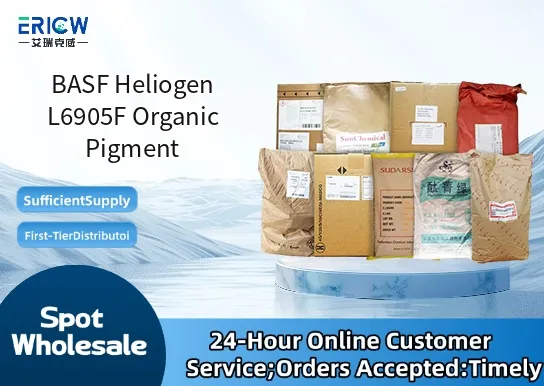
Q1: What is the primary chemical class and typical hue characteristic of Heliogen L6905F?
A: Heliogen L6905F is a high-performance perylene-based organic pigment, offering a clean, bluish-red shade with excellent chroma and strong tinting strength. Its molecular structure delivers inherent resistance to heat, light, and migration in demanding applications.
Q2: In which polymer systems is Heliogen L6905F most commonly processed, and what thermal stability can be expected?
A: This pigment is widely used in engineering thermoplastics such as polyamide (PA), polybutylene terephthalate (PBT), and polyethylene terephthalate (PET). It demonstrates good dispersion stability and retains color integrity during melt processing up to approximately 300 °C, making it suitable for standard injection molding and extrusion conditions.
Q3: Is Heliogen L6905F suitable for applications requiring regulatory compliance for food contact or toys?
A: Heliogen L6905F is not pre-qualified for direct food-contact or toy-safety regulated applications. Its suitability depends on final formulation, processing conditions, and end-use requirements — users must conduct full regulatory assessment and migration testing per applicable regional frameworks before commercial use in such sensitive segments.
Q4: How does Heliogen L6905F compare to conventional quinacridone reds in terms of weathering and chemical resistance?
A: Due to its perylene backbone, Heliogen L6905F offers superior resistance to acidic and alkaline environments, as well as enhanced long-term outdoor durability under UV exposure compared to many quinacridone-based pigments — particularly in unpigmented or lightly stabilized polymer matrices.
Q5: What is the recommended approach for achieving optimal dispersion in masterbatch production?
A: For consistent performance, dispersion should be carried out using high-shear compounding equipment under controlled temperature profiles. Typical carrier resins include low-MI polyolefins or compatible engineering polymers. Dosage generally ranges from 0.1% to 2% by weight depending on the target opacity, color strength, and base resin characteristics.
Contact With Us:
E-mail: wangxingqiang@ericwchem.com
Have a Questions? Call Us:
Add:
Building A1, Jiete Industrial Park, Huangpu District, Guangzhou City, Guangdong Province, China