English
 Español
 tiếng việt
 русский
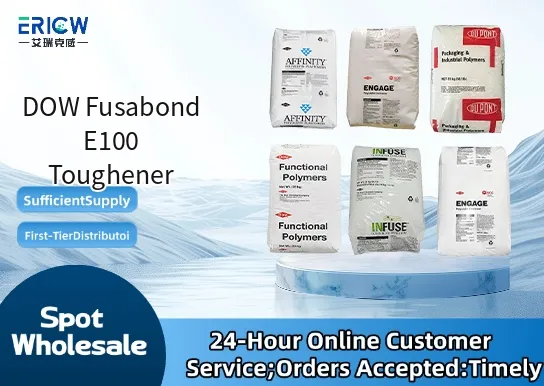
Enhances impact resistance and ductility in polyolefin-based composites without compromising melt processability.
Provides excellent interfacial adhesion between non-polar resins (e.g., PP, PE) and polar fillers or reinforcements.
Enables low-temperature toughness retention in automotive and industrial components exposed to harsh thermal cycling.
Compatible with conventional extrusion, injection molding, and blow molding equipment—no process modification required.
Reduces notch sensitivity and improves crack propagation resistance in structural thermoplastic parts.
Automotive interior and exterior trim components requiring dimensional stability and impact performance.
Under-the-hood parts such as air intake manifolds and fluid reservoirs exposed to elevated temperatures.
Industrial containers and pallets demanding high drop resistance and fatigue durability.
Medical device housings where sterilization compatibility and mechanical reliability are critical.
Consumer appliance housings subject to mechanical stress and aesthetic surface requirements.
| Chemical Type | Maleic anhydride-grafted ethylene–propylene copolymer |
| Product Form | Pellets |
| Appearance | Off-white to light tan, free-flowing cylindrical pellets |
| Primary Applications | Toughening agent for polypropylene (PP), polyethylene (PE), and polyolefin blends |
| Key Features | High graft level, low volatility, thermal stability up to 260°C |
| Benefits | Improved impact strength, enhanced filler dispersion, reduced warpage in molded parts |
| Processing Method | Standard melt compounding (twin-screw extrusion recommended) |
| Storage Conditions | Store in dry, cool conditions; protect from moisture and direct sunlight |
Contact With Us:
E-mail: wangxingqiang@ericwchem.com
Have a Questions? Call Us:
Add:
Building A1, Jiete Industrial Park, Huangpu District, Guangzhou City, Guangdong Province, China