English
 Español
 tiếng việt
 русский
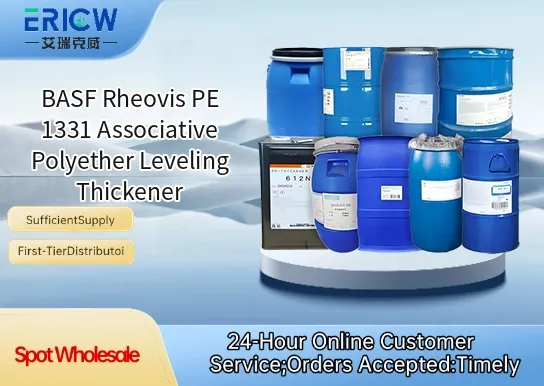
Provides excellent leveling and flow control without compromising sag resistance.
Delivers low-shear viscosity build and efficient rheology modification in waterborne systems.
Offers outstanding compatibility with acrylic, styrene-acrylic, and vinyl acetate-based dispersions.
Enables low foaming performance and minimal impact on gloss retention.
Stabilizes formulations against viscosity drift during storage and freeze-thaw cycling.
Architectural interior and exterior wall paints.
Waterborne industrial maintenance coatings.
Wood finishes and clear varnishes.
Decorative and functional floor coatings.
Low-VOC and eco-label compliant coating systems.
| Chemical Type | Associative polyether thickener (non-ionic) |
| Product Form | Liquid |
| Appearance | Clear to slightly hazy, colorless to pale yellow liquid |
| pH (1% aqueous solution) | 6.0 – 8.0 |
| Active Content | Approx. 25 – 27 wt% |
| Density (20 °C) | Approx. 1.02 – 1.04 g/cm³ |
| Solubility | Readily dispersible in water; miscible with common co-solvents (e.g., glycol ethers) |
| Storage Stability | ≥ 12 months at 5–30 °C in original sealed container |
Q1: What is the primary function of Rheovis PE 1331 in waterborne coatings?
A: Rheovis PE 1331 is an associative polyether thickener designed to provide efficient rheology control—particularly enhancing leveling, sag resistance, and brush/roller drag reduction—while maintaining low high-shear viscosity for good application properties in architectural and industrial waterborne coatings.
Q2: How does Rheovis PE 1331 differ from cellulosic or acrylic thickeners?
A: Unlike cellulosic thickeners, Rheovis PE 1331 offers superior compatibility with surfactants and coalescing agents, reduced sensitivity to electrolytes, and improved spatter resistance. Compared to hydrophobically modified acrylic (HASE) thickeners, it delivers more consistent leveling performance and lower residual tack due to its non-ionic polyether structure.
Q3: Is Rheovis PE 1331 suitable for use in low-VOC or zero-VOC formulations?
A: Yes—Rheovis PE 1331 is a non-ionic, solvent-free, APEO-free polymer dispersion, making it well-suited for low-VOC and zero-VOC compliant waterborne systems without compromising thickening efficiency or film formation.
Q4: What is the recommended addition method and timing during formulation?
A: Rheovis PE 1331 is typically added in the let-down stage, after pigments and fillers have been dispersed and post-added surfactants are fully incorporated. It should be diluted with water or compatible co-solvent before slow, controlled addition under moderate agitation to ensure uniform distribution and avoid localized overdosing.
Q5: Does Rheovis PE 1331 require pH adjustment for optimal performance?
A: No—Rheovis PE 1331 is a non-ionic associative thickener and exhibits stable performance across a broad pH range (typically pH 4–10), eliminating the need for strict pH control unlike many anionic thickeners such as HASE or ASE types.
Contact With Us:
E-mail: wangxingqiang@ericwchem.com
Have a Questions? Call Us:
Add:
Building A1, Jiete Industrial Park, Huangpu District, Guangzhou City, Guangdong Province, China