English
 Español
 tiếng việt
 русский
Effective broad-spectrum biocidal activity against bacteria, fungi, and algae.
Stable in aqueous systems across a wide pH range (pH 4–10).
Low volatility and minimal odor, supporting safer handling and formulation stability.
Compatible with common industrial surfactants, thickeners, and emulsifiers.
Non-oxidizing mode of action, reducing corrosion risk in metal-containing systems.
Preservation of water-based paints and coatings.
Microbial control in metalworking fluids.
Protection of adhesives and sealants during storage and use.
Stabilization of architectural and industrial latex dispersions.
In-process preservation of pigment dispersions and colorants.
| Chemical Type | Isothiazolinone-based biocide (mixture of 5-chloro-2-methyl-4-isothiazolin-3-one and 2-methyl-4-isothiazolin-3-one) |
| Product Form | Aqueous solution |
| Appearance | Clear, pale yellow liquid |
| pH (1% aqueous solution) | 2.0 – 4.0 |
| Density (25 °C) | 1.05 – 1.10 g/cm³ |
| Active Content | 1.5% w/w total isothiazolinones (CMIT/MIT ratio ~3:1) |
| Solubility | Miscible with water; soluble in polar organic solvents (e.g., glycols, alcohols) |
| Primary Applications | Pigment dispersions, latexes, coatings, adhesives, metalworking fluids |
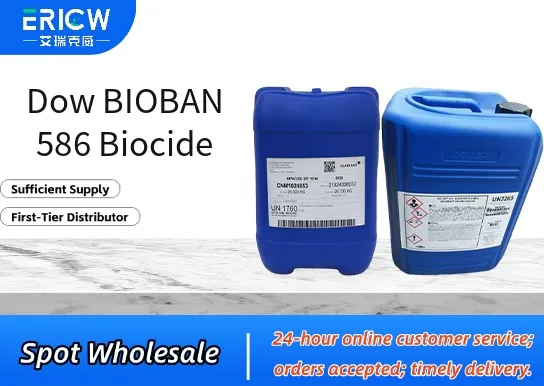
Q1: What is the primary mode of action of Dow BIOBAN 586 Biocide?
A: Dow BIOBAN 586 Biocide functions as a broad-spectrum preservative through disruption of microbial cell membranes and interference with essential metabolic processes, effectively controlling bacteria, yeasts, and molds in aqueous systems.
Q2: In which types of industrial formulations is Dow BIOBAN 586 Biocide commonly used?
A: It is widely employed in water-based industrial products such as metalworking fluids, latex paints and coatings, adhesives, construction chemicals, and cleaning solutions—particularly where long-term microbiological stability and low volatility are required.
Q3: Is Dow BIOBAN 586 Biocide compatible with common formulation ingredients?
A: Yes, it demonstrates good compatibility with anionic, nonionic, and amphoteric surfactants, thickeners, and many common co-biocides; however, compatibility testing under actual formulation conditions is recommended prior to full-scale implementation.
Q4: How should Dow BIOBAN 586 Biocide be handled and stored?
A: Store in original sealed containers at temperatures between 5 °C and 30 °C, away from direct sunlight and strong oxidizing agents. Use appropriate personal protective equipment during handling, and refer to the Safety Data Sheet for detailed guidance on safe use and disposal.
Q5: What is the typical dosage range for effective preservation with Dow BIOBAN 586 Biocide?
A: Effective dosage generally ranges from 0.1% to 2% by weight of the final formulation, depending on system pH, temperature, nutrient load, and microbial challenge; optimization via challenge testing is strongly advised.
Contact With Us:
E-mail: wangxingqiang@ericwchem.com
Have a Questions? Call Us:
Add:
Building A1, Jiete Industrial Park, Huangpu District, Guangzhou City, Guangdong Province, China