English
 Español
 tiếng việt
 русский
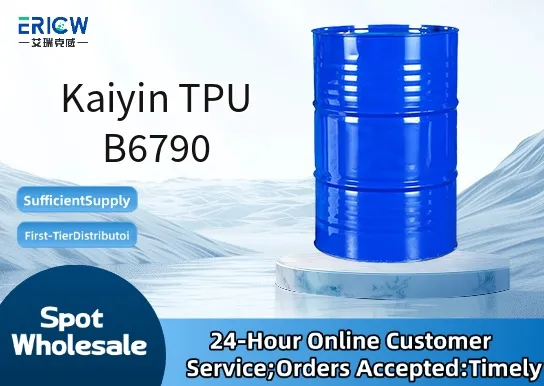
Excellent abrasion resistance for extended service life in demanding mechanical environments.
High elasticity and recovery performance, maintaining shape integrity after repeated deformation.
Good low-temperature flexibility down to –30 °C without significant stiffness increase.
Outstanding oil and grease resistance, suitable for contact with hydrocarbon-based lubricants.
Easy processability via extrusion, injection molding, and calendering with standard TPU equipment.
Automotive interior trim components including instrument panel skins and door armrests.
Industrial conveyor belts requiring high wear resistance and dynamic load capability.
Flexible hoses and tubing for pneumatic and hydraulic systems.
Protective covers and gaskets for electronic enclosures and outdoor equipment.
High-performance footwear midsoles and outsoles demanding resilience and traction.
| Chemical Type | Aliphatic polyester-based thermoplastic polyurethane |
| Product Form | Pellets |
| Appearance | Off-white to light beige, free-flowing granules |
| Shore A Hardness (ASTM D2240) | 85 ± 2 |
| Density (ASTM D792) | 1.18–1.20 g/cm³ |
| Melt Flow Index (210 °C/10 kg, ASTM D1238) | 10–14 g/10 min |
| Processing Temperature Range | 180–220 °C |
| Key Features | Hydrolysis-resistant, non-yellowing, RoHS-compliant |
Q1: What is Kaiyin TPU B6790 primarily used for?
A: Kaiyin TPU B6790 is a thermoplastic polyurethane elastomer designed for high-performance flexible applications, including soft-touch overmolding, elastic films, and durable extruded profiles—particularly where excellent melt processability, abrasion resistance, and low-temperature flexibility are required.
Q2: Is Kaiyin TPU B6790 suitable for injection molding and extrusion?
A: Yes—it exhibits good thermal stability and consistent melt flow behavior, making it well-suited for conventional injection molding, extrusion, and calendering processes. Optimal processing temperatures typically range between 180–220 °C, depending on equipment and part geometry.
Q3: How does Kaiyin TPU B6790 compare to standard polyester-based TPUs in terms of hydrolysis resistance?
A: As an ether-based TPU, B6790 offers significantly improved resistance to hydrolysis and moisture-induced degradation compared to many polyester-type TPUs—making it preferred for long-term outdoor use or humid environments without requiring additional stabilizers.
Q4: Can Kaiyin TPU B6790 be blended with other polymers?
A: Yes—B6790 demonstrates good compatibility with certain polyolefins, ABS, and other TPUs when used as a modifier or impact enhancer. Compatibility and phase morphology should be evaluated experimentally for each specific blend system.
Contact With Us:
E-mail: wangxingqiang@ericwchem.com
Have a Questions? Call Us:
Add:
Building A1, Jiete Industrial Park, Huangpu District, Guangzhou City, Guangdong Province, China