English
 Español
 tiếng việt
 русский
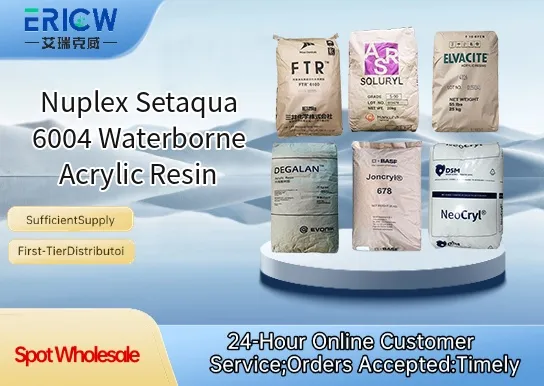
High solids content for improved film build and reduced VOC emissions.
Excellent hydrolytic stability enabling long shelf life and consistent performance in water-based formulations.
Good pigment wetting and dispersion stability for enhanced color development and gloss retention.
Low minimum film formation temperature (MFFT) for ambient-cure applications without coalescent aids.
Compatible with common waterborne crosslinkers including aziridines and melamine formaldehydes.
Architectural interior and exterior wall paints.
Industrial maintenance coatings for metal substrates.
Wood coatings requiring low-odor, low-VOC compliance.
Plastic coatings for ABS and PVC substrates.
Waterborne can and coil coatings requiring good corrosion resistance.
| Chemical Type | Acrylic copolymer emulsion |
| Product Form | White to slightly bluish opaque liquid |
| Appearance | Stable milky dispersion |
| Solids Content (wt%) | 55.0 ± 1.0 |
| pH | 8.0 – 9.0 |
| Viscosity (mPa·s, Brookfield RVT, #2 spindle, 20 rpm) | 150 – 400 |
| Minimum Film Formation Temperature (MFFT) | 12 °C |
| Particle Size (D50, nm) | 120 – 180 |
Q1: What is the primary application of Setaqua 6004 in waterborne coatings?
A: Setaqua 6004 is primarily used as a film-forming binder and rheology modifier in high-performance architectural and industrial waterborne coatings, where it contributes to excellent scrub resistance, gloss retention, and low-temperature film formation.
Q2: Is Setaqua 6004 compatible with common waterborne acrylic emulsions and co-binders?
A: Yes, Setaqua 6004 exhibits broad compatibility with standard anionic and nonionic acrylic, styrene-acrylic, and vinyl acetate-based emulsions, and is commonly incorporated into hybrid systems without destabilization when added during the let-down stage.
Q3: How should Setaqua 6004 be incorporated into a formulation to avoid viscosity spikes or phase separation?
A: It is recommended to add Setaqua 6004 gradually under moderate agitation during the post-addition (let-down) phase, after pigment dispersion and pH adjustment. Pre-dilution with a portion of the formulation water may help ensure uniform incorporation and minimize transient viscosity increases.
Q4: Does Setaqua 6004 contribute to improved freeze-thaw stability in waterborne coatings?
A: While not a dedicated freeze-thaw stabilizer, Setaqua 6004’s molecular architecture supports enhanced colloidal stability in formulated systems, and many users report improved resistance to viscosity drift and coalescence after multiple freeze-thaw cycles—particularly when combined with appropriate protective colloids and co-solvents.
Contact With Us:
E-mail: wangxingqiang@ericwchem.com
Have a Questions? Call Us:
Add:
Building A1, Jiete Industrial Park, Huangpu District, Guangzhou City, Guangdong Province, China