English
 Español
 tiếng việt
 русский
High chroma and excellent color consistency for precise batch-to-batch reproduction.
Optimized rheology for easy dispersion in water-based and solvent-based systems without grinding.
Enhanced lightfastness and thermal stability suitable for medium-temperature processing (up to 180°C).
Low volatile organic compound (VOC) content, compliant with global environmental regulations.
Non-settling formulation with superior storage stability (>24 months at 5–30°C).
Architectural coatings and interior wall paints.
Industrial maintenance coatings for metal and concrete substrates.
Plastic masterbatches for extrusion and injection molding (PVC, PS, ABS).
Printing inks for flexographic and gravure applications.
Wood stains and transparent decorative finishes.
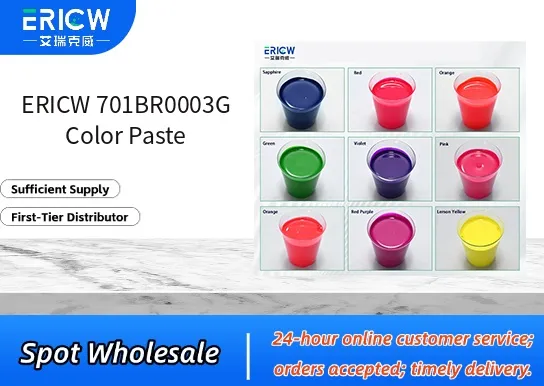
| Chemical Type | Organic pigment dispersion in acrylic polymer carrier |
| Product Form | Viscous liquid paste |
| Appearance | Homogeneous, non-separating brown paste |
| Primary Applications | Water-based and solvent-based coatings, plastics, inks |
| Key Features | Easy dispersion, high tinctorial strength, low dust generation |
| Benefits | Reduced mixing time, improved color accuracy, enhanced operator safety |
| pH (25°C) | 7.2–7.8 |
| Storage Temperature | 5–30°C in sealed original container |
Q1: What is the primary application field for ERICW 701BR0003G Color Paste?
A: ERICW 701BR0003G is specifically formulated for coloring polyolefin-based compounds, including PP and HDPE, and is widely used in injection molding, blow molding, and extrusion applications for consumer goods, automotive interior components, and industrial packaging.
Q2: Is this color paste compatible with food-contact polyolefin applications?
A: ERICW 701BR0003G is designed to meet general requirements for food-contact compliance in polyolefins, subject to final formulation validation and regulatory review by the end user. It contains no intentionally added heavy metals or restricted azo dyes, and its suitability depends on the full compound composition and processing conditions.
Q3: How should ERICW 701BR0003G be incorporated into a polymer matrix?
A: This paste is typically introduced via masterbatch dilution or direct gravimetric feeding during compounding. For optimal dispersion, it is recommended to process at standard polyolefin melt temperatures with sufficient shear history—pre-drying is not required due to its low moisture sensitivity.
Q4: What is the typical dosage range for achieving target color intensity?
A: Dosage varies based on substrate, desired shade depth, and processing method, but generally ranges from 0.1% to 2% by weight relative to the base polymer. Final concentration should be optimized through small-scale trials to balance color consistency, dispersion quality, and cost efficiency.
Q5: Does ERICW 701BR0003G exhibit good thermal stability during high-speed extrusion?
A: Yes—this paste demonstrates robust thermal stability under typical polyolefin processing conditions, including extended residence times at temperatures up to 260°C. Its pigment system and carrier matrix are engineered to minimize degradation, blooming, or hue shift during high-shear operations.
Contact With Us:
E-mail: wangxingqiang@ericwchem.com
Have a Questions? Call Us:
Add:
Building A1, Jiete Industrial Park, Huangpu District, Guangzhou City, Guangdong Province, China