English
 Español
 tiếng việt
 русский
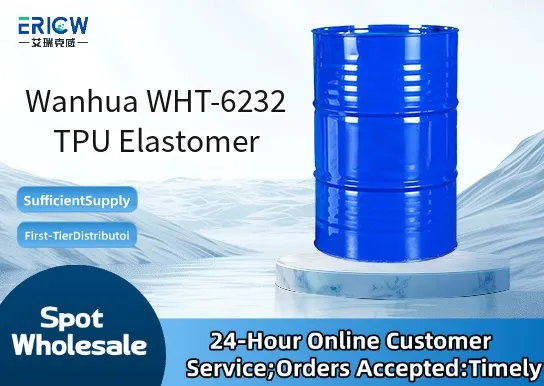
Excellent abrasion resistance for extended service life in demanding mechanical environments.
High tensile strength and elongation at break, ensuring superior mechanical resilience.
Good low-temperature flexibility down to –30 °C, maintaining performance in cold conditions.
Outstanding oil and grease resistance, ideal for industrial and automotive contact applications.
Compatible with common thermoplastic processing methods including extrusion, injection molding, and blow molding.
Automotive interior trim components such as instrument panel skins and door armrests.
Industrial hoses and fluid-conveying tubing requiring chemical and wear resistance.
Footwear midsoles and outsoles demanding rebound elasticity and durability.
Consumer electronics protective casings and soft-touch overmolded grips.
Medical device tubing and non-implantable components requiring biocompatibility support (ISO 10993 tested).
| Chemical Type | Thermoplastic Polyurethane (TPU), Polyester-based |
| Product Form | Pellets |
| Appearance | Off-white to light yellow, free-flowing granules |
| Primary Applications | Extrusion, injection molding, blow molding |
| Key Features | Abrasion resistance, oil resistance, low-temperature flexibility |
| Benefits | Enhanced part longevity, process efficiency, design versatility |
| Density (g/cm³) | 1.20–1.24 |
| Melt Flow Index (210 °C/5 kg, g/10 min) | 10–14 |
Q1: What are the key processing advantages of WHT-6232 compared to conventional aromatic TPUs?
A: WHT-6232 offers improved melt stability and reduced extrusion pressure during processing, supporting smoother operation in film casting, calendering, and blown-film applications. Its optimized rheology allows for better dimensional control and surface finish without requiring major equipment modifications.
Q2: Is WHT-6232 suitable for applications requiring good low-temperature flexibility and abrasion resistance?
A: Yes — WHT-6232 delivers balanced elastomeric performance, including retained flexibility down to approximately −30 °C and robust resistance to mechanical wear, making it well-suited for demanding flexible packaging films, protective coatings, and technical textile laminates.
Q3: How does WHT-6232 perform in terms of adhesion to common substrates like PET, PA, and aluminum foil?
A: WHT-6232 exhibits strong inherent adhesion to polyester (PET), polyamide (PA), and metallized surfaces, often eliminating or reducing the need for primers in lamination processes. Adhesion strength can be further enhanced through standard corona or plasma pretreatment.
Q4: Can WHT-6232 be used in solvent-based or hot-melt adhesive formulations?
A: WHT-6232 is compatible with common organic solvents such as MEK, toluene, and THF, and is frequently employed in solvent-borne adhesive systems. It also functions effectively in thermoplastic hot-melt formulations where clarity, toughness, and thermal reversibility are required.
Contact With Us:
E-mail: wangxingqiang@ericwchem.com
Have a Questions? Call Us:
Add:
Building A1, Jiete Industrial Park, Huangpu District, Guangzhou City, Guangdong Province, China