English
 Español
 tiếng việt
 русский
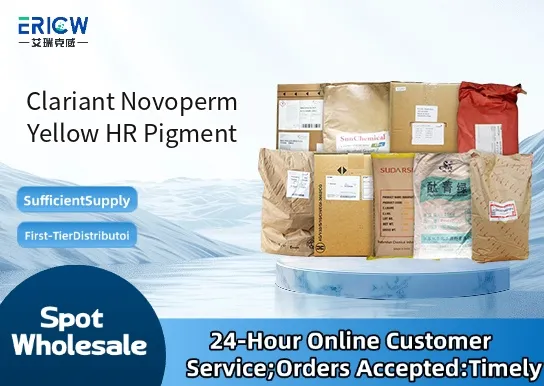
High chroma and excellent lightfastness in demanding outdoor applications.
Superior thermal stability suitable for high-temperature processing up to 280 °C.
Excellent dispersibility in both solvent-based and water-based systems.
Good migration resistance in PVC, polyolefins, and engineering plastics.
REACH-compliant and free of heavy metals, azo dyes, and CMR substances.
Automotive coatings requiring long-term weatherability and gloss retention.
Plastic coloration for exterior automotive parts and construction profiles.
Industrial coil coatings exposed to UV and humidity cycles.
High-performance inks for packaging films and flexible laminates.
Masterbatches for polypropylene (PP), polyethylene (PE), and ABS.
| Chemical Type | Condensed Azo Pigment (Pigment Yellow 154) |
| Product Form | Free-flowing powder |
| Appearance | Bright reddish yellow powder |
| Primary Applications | Plastics, coatings, inks |
| Key Features | High thermal stability, excellent lightfastness, low volatility |
| Benefits | Consistent batch-to-batch color match, low dust generation, good rheology control |
| Regulatory Compliance | REACH registered, EU RoHS compliant, FDA non-food contact compliant |
| Storage Conditions | Store in cool, dry place; protect from moisture and direct sunlight |
Q1: What is the primary chemical class of Novoperm Yellow HR?
A: Novoperm Yellow HR is a high-performance perylene-based organic pigment, known for its exceptional thermal stability, lightfastness, and resistance to migration in demanding polymer applications.
Q2: Is Novoperm Yellow HR suitable for food-contact plastics?
A: Novoperm Yellow HR is not pre-approved for direct food-contact applications under major global regulatory frameworks. Its use in food-contact polymers requires full formulation-level compliance assessment by the end-user, including evaluation of extractables, processing conditions, and intended exposure scenarios.
Q3: How does Novoperm Yellow HR perform in high-temperature processing such as injection molding of engineering thermoplastics?
A: This pigment exhibits excellent thermal stability and retains its color strength and hue integrity during high-temperature processing — including polyesters, polyamides, and polypropylene — without significant decomposition or blooming under standard industrial conditions.
Q4: What dispersion methods are recommended for optimal performance in masterbatch production?
A: For consistent dispersion and maximum color development, high-shear compounding (e.g., twin-screw extrusion) is strongly recommended. Pre-wetting with compatible carrier resins and controlled temperature profiles help minimize agglomeration and ensure uniform distribution in final compounds.
Contact With Us:
E-mail: wangxingqiang@ericwchem.com
Have a Questions? Call Us:
Add:
Building A1, Jiete Industrial Park, Huangpu District, Guangzhou City, Guangdong Province, China