English
 Español
 tiếng việt
 русский
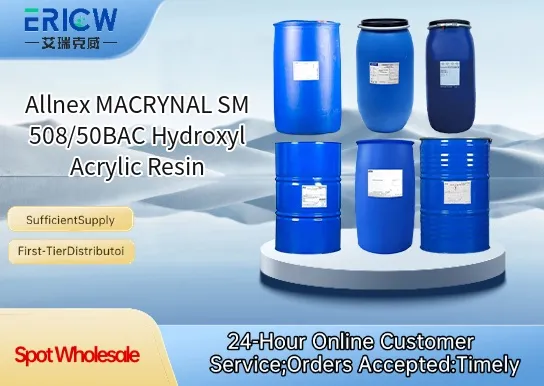
High hydroxyl functionality for efficient crosslinking with melamine, polyisocyanate, and other curing agents.
Excellent compatibility with common solvent-based coating systems and co-resins.
Delivers superior hardness, gloss retention, and chemical resistance in cured films.
Optimized molecular weight distribution for balanced flow, leveling, and film formation.
Low color and high clarity—ideal for transparent and pigmented topcoat applications.
Automotive OEM clearcoats and basecoats.
Industrial maintenance coatings for metal substrates.
General-purpose coil coatings requiring durability and UV stability.
High-performance wood finishes for furniture and cabinetry.
Powder coating hybrid systems (liquid primers or flow-control modifiers).
| Chemical Type | Hydroxyl-functional acrylic copolymer |
| Product Form | Liquid resin in organic solvent blend |
| Appearance | Clear, pale yellow liquid |
| Hydroxyl Value (mg KOH/g) | 135–145 |
| Acid Value (mg KOH/g) | < 5 |
| Non-Volatile Content (% w/w) | 50 ± 2 |
| Solvent System | Xylene / butyl acetate / ester blend |
| Viscosity (25°C, mPa·s) | 4,000–6,000 |
Q1: What is the primary function of MACRYNAL SM 508/50BAC in coating formulations?
A: MACRYNAL SM 508/50BAC serves as a hydroxyl-functional acrylic resin that provides crosslinking sites for reaction with melamine, urea, or polyisocyanate curing agents. It contributes to film hardness, gloss retention, weather resistance, and chemical durability in thermosetting coatings.
Q2: Is this resin compatible with common industrial crosslinkers?
A: Yes, MACRYNAL SM 508/50BAC is formulated for compatibility with standard amino resins (e.g., high- and low-methylated melamines) and aliphatic polyisocyanates. Compatibility and cure performance should be verified in the final formulation under intended processing conditions.
Q3: How does the BAC (butyl acrylate co-monomer) content influence film properties?
A: The incorporation of butyl acrylate enhances flexibility, impact resistance, and low-temperature film formation while maintaining balanced hardness and adhesion. This makes the resin particularly suitable for applications requiring both mechanical robustness and substrate conformity.
Q4: Can MACRYNAL SM 508/50BAC be used in low-VOC or high-solids systems?
A: Yes — its molecular design supports formulation into medium-to-high solids solventborne systems. When combined with appropriate solvents and crosslinkers, it enables VOC reduction without compromising cure efficiency or final film performance.
Contact With Us:
E-mail: wangxingqiang@ericwchem.com
Have a Questions? Call Us:
Add:
Building A1, Jiete Industrial Park, Huangpu District, Guangzhou City, Guangdong Province, China