English
 Español
 tiếng việt
 русский
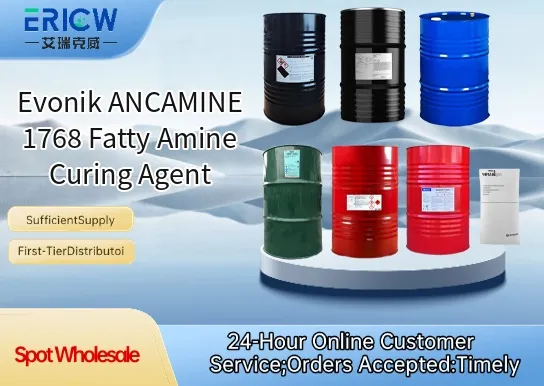
Low-viscosity liquid enabling easy handling and efficient mixing with epoxy resins.
Offers extended pot life at ambient temperatures while delivering rapid cure at elevated temperatures.
Provides excellent flexibility and impact resistance in cured epoxy systems.
Delivers good chemical resistance, particularly to alkalis and solvents.
Derived from renewable fatty acid feedstocks, supporting sustainable formulation goals.
Industrial flooring coatings requiring toughness and chemical resistance.
Marine and offshore protective coatings for steel substrates.
Electrical encapsulation and potting compounds for medium-voltage applications.
Adhesives and composites in wind energy and transportation sectors.
Repair mortars and grouts for concrete infrastructure rehabilitation.
| Chemical Type | Fatty amine-based polyamine |
| Product Form | Liquid |
| Appearance | Pale yellow to amber clear liquid |
| Primary Applications | Epoxy resin curing agent for coatings, adhesives, and composites |
| Key Features | Low viscosity, flexible cure profile, renewable content |
| Benefits | Improved workability, balanced cure speed, enhanced toughness |
| Storage Stability | Stable under dry, cool conditions (≤25°C) for ≥12 months |
| Compatibility | Compatible with standard diglycidyl ether of bisphenol-A (DGEBA) and modified epoxy resins |
Q1: What is the primary function of ANCAMINE 1768 in epoxy systems?
A: ANCAMINE 1768 is a fatty amine-based curing agent designed to react with epoxy resins, enabling crosslinking and development of thermoset properties such as chemical resistance, mechanical strength, and thermal stability.
Q2: Is ANCAMINE 1768 suitable for ambient-cure applications?
A: Yes — it is formulated to provide effective cure at room temperature, making it well-suited for coatings, adhesives, and repair mortars where heat curing is impractical or undesirable.
Q3: How does ANCAMINE 1768 compare to conventional aliphatic amines in terms of handling and safety?
A: As a modified fatty amine, it offers reduced volatility and lower vapor pressure than many standard aliphatic amines, resulting in milder odor and improved workplace handling characteristics — though appropriate ventilation and personal protective equipment are still required.
Q4: Can ANCAMINE 1768 be used in high-solids or solvent-free epoxy formulations?
A: Yes — its low viscosity and good compatibility with common epoxy resins support formulation flexibility, including low-VOC and solvent-free systems commonly used in industrial flooring and protective coatings.
Q5: What factors influence the recommended dosage of ANCAMINE 1768?
A: Dosage depends on the specific epoxy resin type, desired pot life, cure speed, and final performance requirements; it is typically used at low concentrations relative to resin weight, and precise optimization should be determined through laboratory-scale trials.
Contact With Us:
E-mail: wangxingqiang@ericwchem.com
Have a Questions? Call Us:
Add:
Building A1, Jiete Industrial Park, Huangpu District, Guangzhou City, Guangdong Province, China