English
 Español
 tiếng việt
 русский
Low-viscosity liquid polyetheramine offering excellent flow and wetting properties for improved composite processing.
Provides extended pot life and reduced exotherm compared to conventional amine curing agents, enhancing safety and workability.
Delivers superior flexibility and impact resistance in cured epoxy systems without compromising chemical resistance.
Enables room-temperature or elevated-temperature cure with good adhesion to metals, composites, and concrete substrates.
Compatible with standard epoxy resins and supports formulation versatility for structural adhesives, coatings, and composites.
Structural adhesives for aerospace and automotive bonding applications.
High-performance protective coatings for marine, oil & gas, and infrastructure assets.
Matrix resin for fiber-reinforced polymer (FRP) composites used in wind turbine blades and industrial components.
Electrical encapsulation and potting compounds requiring low stress and thermal stability.
Repair mortars and grouts where toughness and moisture tolerance are critical.
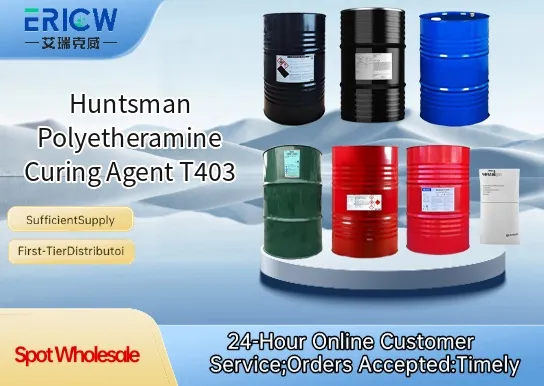
| Chemical Type | Tri-functional polyetheramine (Jeffamine® T403) |
| Product Form | Liquid |
| Appearance | Pale yellow to amber clear liquid |
| Primary Applications | Epoxy curing agent for adhesives, coatings, composites, and grouts |
| Key Features | Low viscosity, flexible cure, extended pot life, low exotherm |
| Benefits | Improved processability, enhanced toughness, broad substrate adhesion, formulation flexibility |
| Storage Stability | Stable under dry, cool conditions (≤25°C); protect from moisture and oxidation |
| Functionality | Approximately 3 active amine hydrogens per molecule |
Q1: What is the primary function of T403 in epoxy resin systems?
A: T403 is a polyetheramine-based curing agent designed to react with epoxy resins to form flexible, tough, and chemically resistant thermoset networks. It imparts low viscosity, extended pot life, and excellent adhesion—particularly valuable in coatings, composites, and adhesive formulations.
Q2: How does T403 compare to aliphatic amine curing agents in terms of handling and reactivity?
A: Unlike highly reactive aliphatic amines, T403 offers significantly lower volatility, reduced skin irritation potential, and slower reaction kinetics—enabling improved processing window and safer industrial handling without compromising final mechanical performance.
Q3: Is T403 suitable for high-performance composite applications such as wind blade bonding or aerospace prepregs?
A: Yes—T403 is widely used in structural composite bonding where elevated toughness, fatigue resistance, and moisture tolerance are required. Its flexible polyether backbone contributes to impact resistance and thermal cycling stability, though final qualification depends on full system formulation and cure profile.
Q4: Can T403 be blended with other curing agents to tailor cure speed or flexibility?
A: Yes—T403 is frequently co-cured with faster-reacting amines (e.g., DETA or IPDA) or aromatic amines to balance pot life, cure temperature, and crosslink density. Compatibility and stoichiometric adjustments should be verified experimentally for each specific resin system.
Q5: What are typical storage and handling recommendations for T403?
A: Store in tightly sealed containers under dry, cool conditions (preferably below 30 °C) and protect from moisture and prolonged exposure to air to prevent viscosity increase or gelation. Use appropriate PPE—including nitrile gloves and eye protection—during handling, as with all amine compounds.
Contact With Us:
E-mail: wangxingqiang@ericwchem.com
Have a Questions? Call Us:
Add:
Building A1, Jiete Industrial Park, Huangpu District, Guangzhou City, Guangdong Province, China