English
 Español
 tiếng việt
 русский
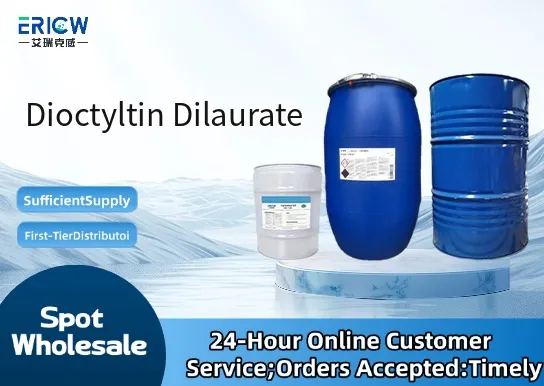
Highly efficient organotin catalyst for polyurethane foam and silicone curing systems.
Excellent hydrolytic stability under ambient storage conditions.
Low volatility and favorable handling characteristics compared to lower-molecular-weight tin catalysts.
Consistent catalytic activity across a broad temperature range (20–120 °C).
Compatible with common foam stabilizers, surfactants, and blowing agents.
Catalyst in flexible and rigid polyurethane foam manufacturing.
Crosslinking accelerator in condensation-cure silicone elastomers (RTV-2).
Reaction promoter in polyester and alkyd resin synthesis.
Stabilizer and co-catalyst in PVC heat stabilization formulations.
Accelerator in moisture-cure sealants and adhesives based on silane-terminated polymers.
| Chemical Type | Dialkyltin diester (organotin compound) |
| Product Form | Clear, pale yellow to amber viscous liquid |
| Appearance | Homogeneous, free from visible particulates or phase separation |
| Melting Point | Approx. 25–30 °C (may solidify at low ambient temperatures; gentle warming restores fluidity) |
| Primary Applications | Polyurethane foams, RTV silicones, moisture-cure sealants |
| Key Features | Non-volatile, thermally stable, low odor |
| Benefits | Enables precise reaction control, reduces post-cure emissions, improves cell structure uniformity |
| Regulatory Compliance | REACH registered; not classified as CMR under CLP Regulation (as of current ECHA dossier) |
| Common Compatible Systems | Suitability |
| Polyether-based flexible PU foams | Highly Recommended – Delivers rapid cream-to-gel transition with fine cell morphology |
| Condensation-cure RTV-2 silicones (e.g., acetoxy, oxime types) | Highly Recommended – Provides reliable cure speed without premature skinning |
| Silane-terminated polymer (STP) sealants | Recommended – Effective at 0.05–0.3 phr; synergistic with titanium chelates |
| PVC thermal stabilizer blends (with Ca/Zn soaps) | Suitable – Acts as secondary stabilizer; limited use due to regulatory constraints in food-contact applications |
Q1: What is the CAS Number for Dioctyltin Dilaurate?
A: The CAS Registry Number is 301-10-0.
Q2: What is the typical dosage range in polyurethane foam formulations?
A: Standard usage is 0.05–0.3 parts per hundred parts polyol (phr), depending on desired reactivity, density, and processing conditions.
Q3: How does Dioctyltin Dilaurate compare to Dibutyltin Dilaurate (DBTDL)?
A: DOTL offers lower volatility, reduced dermal absorption potential, and improved thermal stability versus DBTDL—making it preferred for high-temperature processing and applications requiring longer pot life.
Q4: Is Dioctyltin Dilaurate approved for food-contact or medical applications?
A: It is not authorized under FDA 21 CFR or EU Framework Regulation (EC) No. 1935/2004 for direct food-contact applications. Its use is restricted to industrial intermediates and non-leaching end-products where migration risk is negligible.
Contact With Us:
E-mail: wangxingqiang@ericwchem.com
Have a Questions? Call Us:
Add:
Building A1, Jiete Industrial Park, Huangpu District, Guangzhou City, Guangdong Province, China