English
 Español
 tiếng việt
 русский
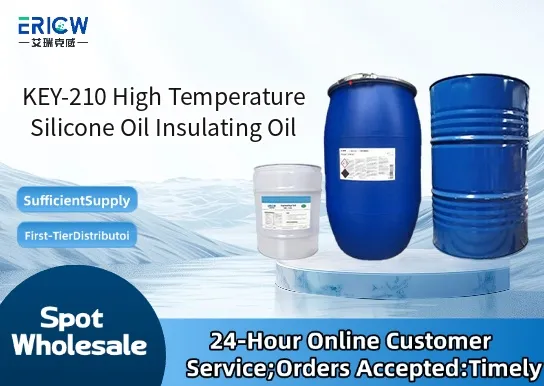
Exceptional thermal stability up to 300 °C continuous service temperature without significant degradation or volatility.
Non-toxic, non-corrosive formulation compatible with copper, aluminum, and common elastomers used in high-temperature electrical systems.
High dielectric strength (>35 kV/mm at 25 °C) and low dielectric loss factor (tan δ < 0.001 at 1 kHz), ensuring reliable insulation performance.
Hydrophobic nature provides excellent resistance to moisture absorption and oxidation under humid or cyclic thermal conditions.
Low surface tension and superior wettability enable uniform coating and effective impregnation of porous insulating materials.
Insulating fluid for high-temperature transformers and reactors operating above 180 °C.
Dielectric coolant in aerospace-grade power electronics and avionics thermal management systems.
Impregnating medium for mica tape, ceramic fiber insulation, and refractory composite windings in industrial heating equipment.
Thermal interface fluid in high-reliability solid-state inverters and EV traction power modules.
Filler oil for hermetically sealed high-temperature sensors and precision transducers exposed to intermittent thermal shock.
| Chemical Type | Linear polydimethylsiloxane (PDMS) with controlled viscosity and end-blocking |
| Product Form | Clear, colorless to pale amber liquid |
| Appearance | Transparent, homogeneous, free from sediment or haze |
| Viscosity (cSt @ 100 °C) | 120–140 |
| Density (g/cm³ @ 25 °C) | 0.96–0.98 |
| Flash Point (°C, Cleveland Open Cup) | ≥320 |
| Dielectric Strength (kV/mm) | >35 (ASTM D877, 2.5 mm gap) |
| Regulatory Compliance | REACH SVHC-free; RoHS 3 compliant; FDA 21 CFR 178.3570 (indirect food contact approved) |
| Common Compatible Systems | Suitability |
| Phenolic resin-bonded mica paper insulation | Highly Recommended – Excellent chemical inertness and thermal adhesion retention |
| Alumina-filled silicone rubber housings | Recommended – Minimal swelling; long-term compatibility verified per UL 746C |
| Copper-wound nickel-plated busbar assemblies | Highly Recommended – No corrosion observed after 1,000 hrs at 250 °C (IEC 60068-2-20) |
| Stainless steel hermetic enclosures (316L) | Suitable – Passes ASTM B117 salt spray test when sealed; no galvanic interaction |
Q1: What is the CAS Registry Number for KEY-210?
A: The CAS number for KEY-210 is 63148-62-9 (representing a purified, viscosity-stabilized PDMS fraction meeting IEC 61099 specifications).
Q2: What is the recommended fill volume or dosage for transformer impregnation?
A: Typical impregnation requires 1.1–1.3× the void volume of the dry winding assembly; vacuum-pressure impregnation (VPI) at 0.1 mbar for 30 min followed by 3–5 bar nitrogen pressure for 60 min ensures complete penetration.
Q3: How does KEY-210 compare to conventional mineral-based insulating oils in high-temperature applications?
A: Unlike mineral oils, KEY-210 exhibits negligible oxidation below 300 °C, no sludge formation, and retains dielectric integrity after 10,000+ thermal cycles — eliminating need for frequent oil replacement or degassing maintenance.
Q4: Is KEY-210 subject to EU POPs Regulation (EU 2019/1021) or US EPA TSCA restrictions?
A: No — KEY-210 contains no persistent organic pollutants (POPs), PCBs, PBBs, PBDEs, or PFAS substances; it is fully compliant with EU POPs Annex I and TSCA Inventory requirements.
Q5: Does KEY-210 migrate or leach into adjacent polymer components during extended thermal aging?
A: Migration is minimal (<0.5 wt% uptake after 2,000 hrs at 250 °C) in validated polymers (e.g., polyimide, FEP, Vespel SP-21); extraction testing per ISO 10993-12 confirms no cytotoxic leachables.
Contact With Us:
E-mail: wangxingqiang@ericwchem.com
Have a Questions? Call Us:
Add:
Building A1, Jiete Industrial Park, Huangpu District, Guangzhou City, Guangdong Province, China