English
 Español
 tiếng việt
 русский
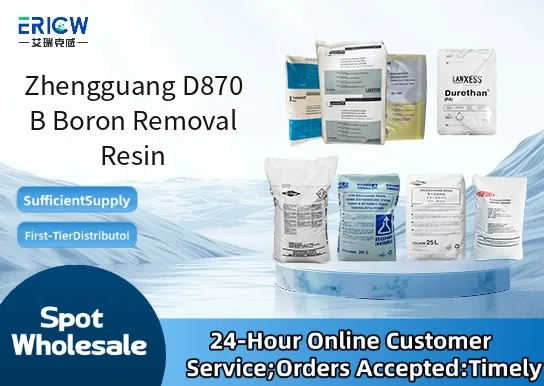
Highly selective chelating functionality optimized for boron adsorption at near-neutral pH.
Stable polyacrylate matrix ensures excellent chemical resistance and long service life in continuous operation.
Fast kinetics and high capacity enable efficient boron removal down to <0.1 ppm in polishing applications.
Regenerable with mild alkaline solutions (e.g., NaOH), minimizing waste and operational cost.
Low pressure drop and uniform bead size support reliable performance in packed-bed and cartridge systems.
Polishing of ultrapure water (UPW) in semiconductor manufacturing facilities.
Boron control in nuclear power plant primary coolant make-up water.
Treatment of desalinated seawater prior to boiler feed or process use.
Final boron polishing in pharmaceutical-grade water (PW/WFI) production systems.
Recycling and reuse of boron-containing process streams in specialty chemical plants.
| Chemical Type | Polyacrylate-based chelating resin with N-methylglucamine functional groups |
| Product Form | Moist, spherical beads |
| Appearance | Off-white to light tan, uniform granules |
| Particle Size Range | 0.3–1.2 mm |
| Uniformity Coefficient | ≤ 1.6 |
| Moisture Content | 45–55% (as shipped) |
| pH Stability Range | 2–12 (short-term exposure); optimal operation: pH 7–10 |
| Maximum Operating Temperature | 60 °C |
Q1: What is the primary application of Zhengguang D870 B resin?
A: Zhengguang D870 B is a specialty chelating ion exchange resin engineered for selective boron removal from aqueous streams, especially in ultrapure water production, pharmaceutical process water polishing, and electronic-grade water systems where low boron content is critical.
Q2: How does D870 B differ from standard strong base anion resins in boron removal?
A: Unlike conventional anion resins, D870 B features a tailored polyamine functional group with high affinity and selectivity for borate species—particularly at near-neutral pH—enabling effective boron capture even in the presence of competing anions like chloride or sulfate.
Q3: What are the recommended operating conditions for optimal boron removal performance?
A: Best performance is achieved at pH 8.0–9.5, with service flow rates typically maintained between 5–15 BV/h. Pre-adjustment of feedwater pH may be necessary to ensure boron exists predominantly as borate, and temperature should remain within ambient to 40 °C for stable capacity and kinetics.
Q4: Can D870 B resin be regenerated, and what regeneration method is recommended?
A: Yes, D870 B is fully regenerable using sodium hydroxide solutions. Regeneration efficiency depends on NaOH concentration, contact time, and temperature; typical practice involves 2–4% NaOH at elevated pH, followed by thorough rinsing to residual boron levels below detection limits.
Q5: Is D870 B compatible with common pretreatment and polishing system configurations?
A: Yes—it is designed for integration into standard ion exchange vessels and mixed-bed systems, and performs reliably downstream of reverse osmosis or electrodialysis units. Compatibility with stainless steel, UPVC, and FRP system materials is well established under typical water treatment operating conditions.
Contact With Us:
E-mail: wangxingqiang@ericwchem.com
Have a Questions? Call Us:
Add:
Building A1, Jiete Industrial Park, Huangpu District, Guangzhou City, Guangdong Province, China