English
 Español
 tiếng việt
 русский
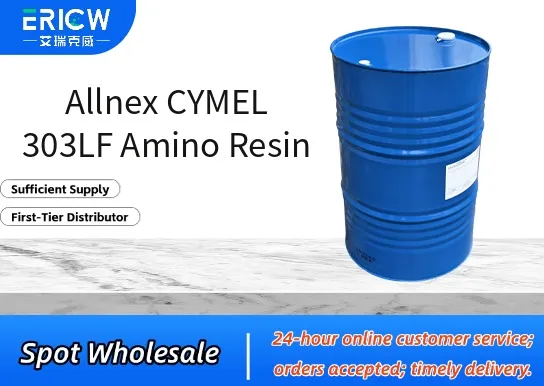
Low formaldehyde emission, meeting stringent global regulatory requirements for indoor air quality.
Excellent compatibility with acrylic, polyester, and alkyd resins in thermosetting coatings.
Fast cure kinetics at moderate baking temperatures (140–160 °C), enabling high-throughput industrial coating lines.
Superior gloss retention and hardness development in baked finishes.
Good storage stability in solvent-based systems without premature self-condensation.
Automotive OEM and refinish topcoats requiring high durability and aesthetic performance.
Appliance coatings for refrigerators, washing machines, and ovens.
General metal packaging coatings, including food-can interiors and exterior lacquers.
Industrial coil coatings for pre-painted steel and aluminum substrates.
Functional coatings for HVAC components and office furniture substrates.
| Chemical Type | Methylated melamine-formaldehyde resin |
| Product Form | Liquid, solvent-based solution |
| Appearance | Clear, pale yellow liquid |
| Non-Volatile Content (wt%) | 80 ± 1 |
| Viscosity (mPa·s, 25 °C) | 800–1,200 |
| Density (g/cm³, 25 °C) | 1.08–1.12 |
| Solvent | n-Butanol / xylene blend |
| Primary Applications | Thermosetting decorative and protective coatings for metal substrates |
Q1: What is the primary function of CYMEL 303LF in coating formulations?
A: CYMEL 303LF functions as a low-formaldehyde melamine-formaldehyde crosslinker, enabling thermoset curing of hydroxyl- or carboxyl-functional resins—such as acrylics, alkyds, and polyesters—at moderate baking temperatures. It contributes to improved hardness, chemical resistance, and gloss retention in final coatings.
Q2: How does CYMEL 303LF differ from standard high-formaldehyde melamine resins?
A: CYMEL 303LF is specifically engineered with reduced free formaldehyde content and enhanced hydrolytic stability compared to conventional melamine crosslinkers. This supports safer handling, lower emissions during cure, and improved compatibility in waterborne and high-solids systems without compromising reactivity or film performance.
Q3: What are typical curing conditions when using CYMEL 303LF?
A: Optimal cure typically occurs between 120 °C and 160 °C for 15–30 minutes, depending on substrate, film thickness, and resin system. Its reactivity profile allows flexibility for both coil and general industrial coating applications, and it can be effectively catalyzed with weak organic acids to fine-tune gel time and through-cure.
Q4: Is CYMEL 303LF suitable for waterborne coating systems?
A: Yes—CYMEL 303LF exhibits good compatibility and colloidal stability in many waterborne acrylic and polyester dispersions. Its low free formaldehyde and optimized solubility characteristics support formulation of environmentally compliant, low-VOC industrial coatings without significant risk of haze or viscosity instability.
Contact With Us:
E-mail: wangxingqiang@ericwchem.com
Have a Questions? Call Us:
Add:
Building A1, Jiete Industrial Park, Huangpu District, Guangzhou City, Guangdong Province, China