English
 Español
 tiếng việt
 русский
High melt strength and excellent processability in extrusion and injection molding
Outstanding elasticity and recovery after repeated deformation
Good compatibility with polypropylene (PP) and polyethylene (PE) for thermoplastic vulcanizate (TPV) formulations
Enhanced UV and thermal stability versus conventional SBS-based elastomers
Low extractables and compliant with FDA 21 CFR §177.2600 for food-contact applications
Soft-touch overmolding for automotive interior components
Flexible grips and ergonomic handles for power tools and consumer electronics
Sealants and gasket compounds requiring low compression set and weather resistance
Medical device tubing and non-latex elastomeric components
High-performance thermoplastic vulcanizates (TPVs) for demanding industrial applications
| Chemical Type | Styrene–Ethylene/Butylene–Styrene (SEBS) triblock copolymer |
| Product Form | Pellets |
| Appearance | Off-white to light tan, free-flowing pellets |
| Primary Applications | Thermoplastic elastomer (TPE) compounding, soft-touch overmolding, TPV base resin |
| Key Features | High elasticity, PP/PE compatibility, low compression set, FDA-compliant |
| Benefits | Improved processing efficiency, enhanced part durability, recyclability in TPE streams |
| Storage Recommendation | Store in cool, dry conditions; protect from direct sunlight and moisture |
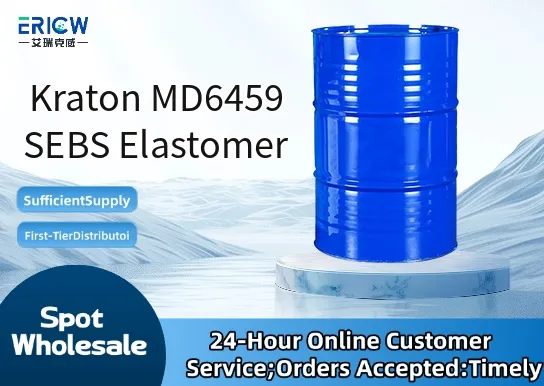
Q1: What is Kraton MD6459 and how does it differ from other SEBS grades?
A: Kraton MD6459 is a selectively hydrogenated styrenic block copolymer (SEBS) elastomer designed for high clarity, excellent melt processability, and balanced mechanical properties. It features a mid-range molecular weight and controlled styrene content, offering improved flow characteristics and lower viscosity compared to higher-MW SEBS grades—making it especially suitable for thin-wall injection molding and extrusion applications where surface aesthetics and dimensional stability are critical.
Q2: Is Kraton MD6459 compatible with polypropylene (PP) and polyethylene (PE) in thermoplastic vulcanizates (TPVs)?
A: Yes, Kraton MD6459 is widely used as the soft-phase elastomer component in PP- and PE-based TPVs. Its saturated mid-block provides excellent compatibility with polyolefin matrices, supporting efficient dynamic vulcanization and contributing to good tensile strength, elongation recovery, and thermal stability in the final compound.
Q3: Can Kraton MD6459 be used in medical or food-contact applications?
A: Kraton MD6459 is manufactured under strict quality controls and is commonly selected for medical device components and food-contact applications where regulatory compliance is required. However, final suitability depends on the complete formulation, processing conditions, and end-use requirements—users must conduct appropriate testing and verification per applicable regional regulations and intended application standards.
Q4: How should Kraton MD6459 be dried prior to processing?
A: While Kraton MD6459 exhibits low hygroscopicity, it is recommended to dry the material before high-temperature processing (e.g., injection molding above 220 °C) to minimize potential moisture-related defects such as splay or reduced melt strength. A typical drying condition is 60–70 °C for 2–4 hours using desiccant or dehumidifying equipment.
Contact With Us:
E-mail: wangxingqiang@ericwchem.com
Have a Questions? Call Us:
Add:
Building A1, Jiete Industrial Park, Huangpu District, Guangzhou City, Guangdong Province, China