English
 Español
 tiếng việt
 русский
Excellent abrasion resistance for extended service life in dynamic applications.
Outstanding oil and grease resistance, maintaining mechanical integrity in lubricated environments.
Good low-temperature flexibility down to –40 °C without brittle failure.
High tensile strength and elongation at break for demanding mechanical performance.
Processable via standard thermoplastic methods including extrusion, injection molding, and calendering.
Industrial hoses and hydraulic tubing requiring chemical and wear resistance.
Automotive air ducts, bellows, and vibration-damping components.
Conveyor belts and scraper blades in material handling systems.
Seals, gaskets, and dynamic sealing elements for machinery and equipment.
Roller coverings and precision rollers for printing and paper processing.
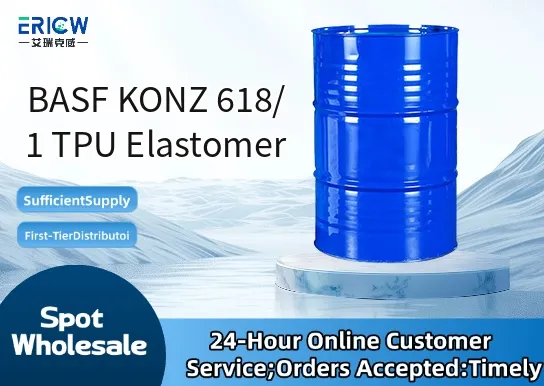
| Chemical Type | Thermoplastic Polyurethane (TPU), polyester-based |
| Product Form | Pellets |
| Appearance | Off-white to light beige granules |
| Primary Applications | Extruded profiles, molded parts, flexible tubing, industrial seals |
| Key Features | High abrasion resistance, oil/grease resistance, good low-temp flexibility |
| Processing Methods | Extrusion, injection molding, calendering |
| Density (g/cm³) | 1.18–1.22 |
| Melt Flow Index (230 °C / 5 kg) | 8–12 g/10 min |
Q1: What is the primary function of BASF KONZ 618/1 in TPU formulations?
A: BASF KONZ 618/1 is a specialized processing aid designed to improve melt flow, reduce extrusion pressure, and enhance surface finish in thermoplastic polyurethane (TPU) compounds—particularly during extrusion and injection molding processes.
Q2: Is KONZ 618/1 compatible with all major TPU chemistries (e.g., polyester-, polyether-, and polycaprolactone-based TPUs)?
A: Yes, KONZ 618/1 demonstrates broad compatibility across common TPU base resins. It is especially effective in demanding applications involving high-molecular-weight or highly viscous TPUs where lubricity and dispersion stability are critical.
Q3: How is KONZ 618/1 typically incorporated into TPU production?
A: It is generally added during compounding—either pre-blended with TPU pellets or introduced via side-feeding in twin-screw extrusion. Due to its solid, free-flowing nature, it disperses readily without requiring solvents or pre-dilution.
Q4: Does KONZ 618/1 affect the mechanical or thermal properties of the final TPU part?
A: When used within recommended dosage ranges, KONZ 618/1 has minimal impact on tensile strength, elongation, or heat resistance. Its primary influence is rheological—not structural—so key performance attributes of the base TPU are preserved.
Contact With Us:
E-mail: wangxingqiang@ericwchem.com
Have a Questions? Call Us:
Add:
Building A1, Jiete Industrial Park, Huangpu District, Guangzhou City, Guangdong Province, China