English
 Español
 tiếng việt
 русский
Excellent soft-touch feel with balanced elasticity and recovery performance.
Good processability on standard injection molding and extrusion equipment.
Enhanced thermal stability for consistent output during high-speed production.
Low extractables and compliant with RoHS and REACH regulatory requirements.
Superior adhesion to polypropylene (PP) and polyethylene (PE) substrates without primer.
Overmolding of automotive interior trim components.
Soft-grip handles for power tools and consumer appliances.
Sealing rings and gaskets in household appliances.
Ergonomic grips for medical device housings.
Flexible hinges and living hinges in packaging closures.
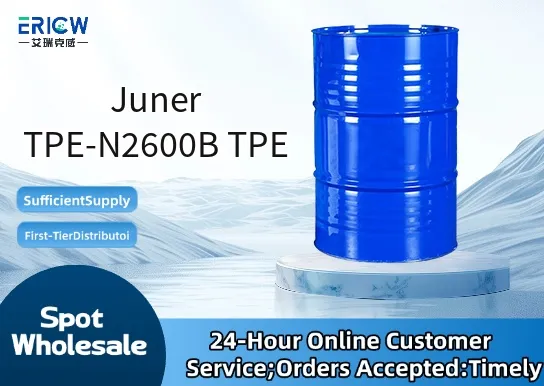
| Chemical Type | Thermoplastic Elastomer (TPE), SEBS-based |
| Product Form | Pellets |
| Appearance | Translucent, light amber granules |
| Hardness (Shore A) | 65 ± 3 |
| Melt Flow Rate (190°C/2.16 kg) | 12–18 g/10 min |
| Density | 0.92–0.94 g/cm³ |
| Primary Applications | Overmolding, soft-touch finishing, flexible sealing |
| Key Features | PP/PE adhesion, low odor, recyclable |
Q1: What is the primary function of Juner TPE-N2600B in thermoplastic elastomer formulations?
A: Juner TPE-N2600B is a functionalized thermoplastic elastomer modifier designed to enhance melt processability, improve interfacial adhesion between incompatible polymer phases, and support consistent dispersion of fillers or additives in TPE blends—particularly in SEBS- or TPE-S-based systems.
Q2: Is Juner TPE-N2600B suitable for food-contact or medical-grade applications?
A: Juner TPE-N2600B is not pre-certified for food-contact or medical use. Its suitability for such applications depends on full formulation evaluation, including regulatory review of all components, processing conditions, and final product testing. Customers must conduct their own compliance verification with relevant authorities.
Q3: How should Juner TPE-N2600B be incorporated into a TPE compound?
A: It is typically added during the compounding stage—either directly with base polymers in a twin-screw extruder or via masterbatch dilution. Optimal incorporation occurs at temperatures compatible with the host TPE matrix, generally between 180–220 °C, with sufficient residence time to ensure uniform dispersion without thermal degradation.
Q4: Does Juner TPE-N2600B require drying before processing?
A: Yes—like most hygroscopic thermoplastic elastomers, Juner TPE-N2600B benefits from pre-drying at 60–70 °C for 2–4 hours prior to high-temperature processing to minimize moisture-related defects such as splay, bubbles, or reduced mechanical performance.
Contact With Us:
E-mail: wangxingqiang@ericwchem.com
Have a Questions? Call Us:
Add:
Building A1, Jiete Industrial Park, Huangpu District, Guangzhou City, Guangdong Province, China