English
 Español
 tiếng việt
 русский
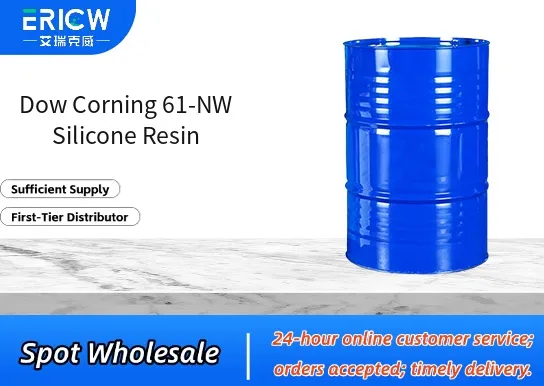
High thermal stability with continuous service up to 200 °C.
Excellent electrical insulation properties, even under humid conditions.
Good compatibility with organic resins and pigments for hybrid formulation systems.
Low surface energy enabling superior release performance and anti-stick behavior.
Non-yellowing character ensures long-term clarity and color stability in demanding applications.
Heat-resistant coatings for industrial ovens and baking equipment.
Electrical insulating varnishes for motors, transformers, and coil windings.
Release agents for silicone-free composite molding and RTM processes.
Surface modifiers for high-performance architectural sealants and elastomers.
Binders in high-temperature pigment dispersions for ceramic and metal decoration.
| Chemical Type | Methyl-phenyl silicone resin |
| Product Form | Clear, viscous liquid |
| Appearance | Colorless to pale yellow, transparent |
| Solvent System | Xylene-based solution |
| Non-Volatile Content | 55–60 wt% (at 150 °C, 60 min) |
| Viscosity (25 °C) | 800–1,200 cP (Brookfield, spindle #3, 12 rpm) |
| Specific Gravity (25 °C) | 0.97–1.00 g/cm³ |
| Flash Point (Tag Closed Cup) | Approx. 32 °C |
Q1: What is the primary function of Dow Corning 61-NW in coating formulations?
A: Dow Corning 61-NW is a non-reactive, methyl-phenyl silicone resin designed to enhance surface properties—particularly slip, mar resistance, and water repellency—in solvent-based and high-solids coatings. It functions as a surface modifier rather than a film-forming binder.
Q2: Is Dow Corning 61-NW compatible with common organic resins and solvents?
A: Yes—it exhibits broad compatibility with acrylics, alkyds, polyurethanes, and epoxy resins in conventional solvent systems such as xylene, toluene, and glycol ethers. Compatibility should always be verified in the final formulation due to potential interactions with highly polar or reactive components.
Q3: How is Dow Corning 61-NW typically incorporated into a coating system?
A: It is generally added during the let-down or post-addition stage under moderate agitation. Pre-dilution in a compatible solvent is recommended to ensure uniform dispersion and avoid localized concentration effects.
Q4: Does Dow Corning 61-NW contribute to thermal stability or UV resistance in finished films?
A: As a phenyl-containing silicone resin, it imparts improved thermal endurance and inherent UV stability compared to purely methyl-based silicones—supporting performance retention in demanding outdoor or elevated-temperature applications.
Contact With Us:
E-mail: wangxingqiang@ericwchem.com
Have a Questions? Call Us:
Add:
Building A1, Jiete Industrial Park, Huangpu District, Guangzhou City, Guangdong Province, China