English
 Español
 tiếng việt
 русский
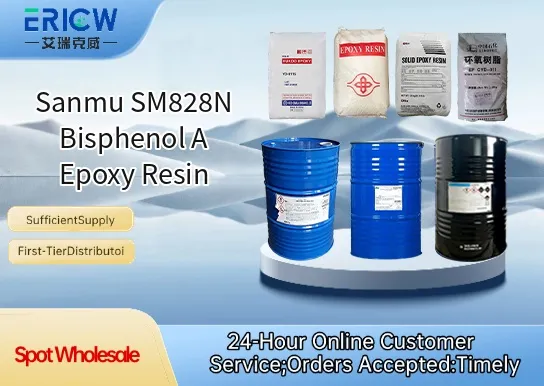
High purity bisphenol A-based epoxy resin with consistent molecular weight distribution.
Excellent thermal stability and low volatility, suitable for high-temperature curing processes.
Low chlorine content (< 800 ppm), ensuring superior electrical insulation and corrosion resistance.
Good compatibility with common amine and anhydride hardeners for versatile formulation flexibility.
Optimized viscosity (12,000–15,000 cP at 25°C) for efficient processing in coating, adhesive, and composite applications.
Electrical laminates for printed circuit boards (PCBs) requiring high dielectric strength.
Structural adhesives in aerospace and automotive bonding assemblies.
High-performance protective coatings for marine and industrial steel structures.
Matrix resin for fiber-reinforced composites in wind turbine blades and sporting goods.
Potting and encapsulation compounds for electronic components and power modules.
| Chemical Type | Bisphenol A epoxy resin (diglycidyl ether) |
| Product Form | Amber to light yellow viscous liquid |
| Appearance | Clear, homogeneous liquid without sediment or haze |
| Epoxy Equivalent Weight (EEW) | 187–193 g/eq |
| Viscosity (25°C) | 12,000–15,000 cP |
| Chlorine Content | ≤ 800 ppm |
| Gardner Color | ≤ 3 |
| Volatiles (150°C, 2 h) | ≤ 0.3 wt% |
Q1: What is the primary functional role of SM828N in epoxy formulations?
A: SM828N serves as a standard-grade liquid bisphenol A epoxy resin, primarily used as the base resin component in thermosetting systems—providing structural backbone, adhesion, chemical resistance, and crosslink density upon curing with appropriate hardeners.
Q2: Is SM828N suitable for applications requiring FDA compliance or food-contact approval?
A: SM828N is not pre-certified for food-contact use. Its suitability for regulated applications depends on final formulation, processing conditions, and end-use regulatory evaluation by the formulator. Customers must conduct full compliance validation per applicable jurisdictional requirements.
Q3: How does SM828N compare to higher-molecular-weight solid epoxy resins in terms of processing?
A: As a low-viscosity liquid resin, SM828N offers excellent processability at ambient temperature—enabling easy mixing, degassing, and impregnation without solvent addition or heating. It is especially suited for casting, coating, and adhesive formulations where handling simplicity and uniform dispersion are critical.
Q4: Which types of curing agents are commonly paired with SM828N?
A: SM828N is compatible with a broad range of amine-based hardeners (e.g., aliphatic, cycloaliphatic, and aromatic amines), anhydrides, and catalytic systems such as Lewis acids or latent accelerators—selection depends on desired cure schedule, thermal performance, and mechanical properties.
Contact With Us:
E-mail: wangxingqiang@ericwchem.com
Have a Questions? Call Us:
Add:
Building A1, Jiete Industrial Park, Huangpu District, Guangzhou City, Guangdong Province, China