English
 Español
 tiếng việt
 русский
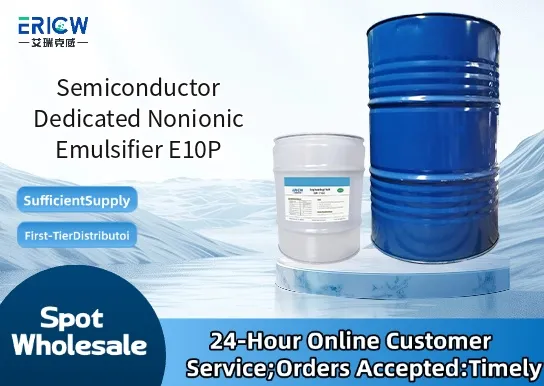
Ultra-low ionic residue to prevent metal ion contamination in semiconductor wet processing.
Exceptional hydrolytic stability under acidic and neutral aqueous conditions (pH 3–7).
Non-volatile, non-foaming formulation designed for precision cleaning and rinse compatibility.
High purity with trace metals (Na, K, Ca, Mg, Fe, Cu, Ni, Zn) individually controlled to <10 ppb levels.
Optimized HLB (~10.2) for stable micelle formation in ultrapure water (UPW) without phase separation.
Photoresist stripper emulsification in advanced node (≤28 nm) wafer fabrication.
Post-etch residue removal for low-k dielectric and copper interconnect processes.
Carrier fluid component in CMP slurry stabilizers for SiO₂ and STI applications.
Surface tension modifier in ultrasonic and megasonic cleaning baths for MEMS and power devices.
Stabilizer for nano-dispersed ceria and silica abrasives in next-generation polishing formulations.
| Chemical Type | Polyoxyethylene (10) alkylphenol ether derivative — phenol-free, branched C₁₂–C₁₅ alcohol ethoxylate |
| Product Form | Clear, viscous liquid at 25 °C |
| Appearance | Colorless to pale yellow, homogeneous, free of particulates |
| Active Content | ≥99.5% (by GC) |
| Primary Applications | Semiconductor wet process emulsification, residue solubilization, and colloidal stabilization |
| Key Features | Nonionic, non-ionic-leaching, UPW-compatible, low TOC contribution (<5 ppm in 1% aqueous solution) |
| Benefits | Reduces post-clean defects, enables sub-10 nm particle dispersion control, eliminates rinse spot formation |
| Regulatory Compliance | REACH registered; RoHS 2 compliant; halogen-free (IEC 61249-2-21); no SVHC on current ECHA Candidate List |
| Common Compatible Systems | Suitability |
| Aqueous-based photoresist strippers (e.g., NMP-free amine/organic acid blends) | Highly Recommended – Maintains emulsion integrity up to 80 °C; no phase separation or gelling |
| Ultrapure water (UPW) rinse systems (18.2 MΩ·cm, TOC <1 ppb) | Highly Recommended – Fully miscible; no film residue or contact angle hysteresis |
| Cerium oxide (CeO₂) CMP slurries (pH 3.5–4.5) | Recommended – Enhances abrasive dispersion stability; no measurable zeta potential shift |
| Fluorinated surfactant blends (e.g., C₆F₁₃CH₂CH₂O(CH₂CH₂O)ₙH) | Suitable – No antagonistic interaction; additive synergy observed in defect reduction |
Q1: What is the CAS Registry Number for E10P?
A: CAS No. 128447-22-1 — verified for the specific branched C₁₂–C₁₅ alcohol ethoxylate composition meeting SEMI F57 purity standards.
Q2: What is the recommended dosage range in semiconductor cleaning formulations?
A: Typical use level is 0.1–0.5 wt% in final process solutions; validated efficacy at 0.25 wt% for 28 nm logic BEOL residue removal per SEMI C11 test protocol.
Q3: How does E10P differ from conventional nonionic emulsifiers like Triton X-100 or Tween 80?
A: Unlike Triton X-100 (alkylphenol-based, banned under EU restrictions) or Tween 80 (polyunsaturated fatty acid ester, prone to oxidation), E10P uses a phenol-free, saturated alkyl chain with controlled ethoxylation—ensuring zero alkylphenol metabolites, superior oxidative stability, and SEMI-certified trace metal profiles.
Q4: Is E10P subject to extractables/leachables concerns in contact with PFA or ETFE fluidic components?
A: No significant extractables detected per USP <87> and <88> cytotoxicity testing; compatible with high-purity fluoropolymer wetted parts when used within recommended temperature (≤60 °C) and concentration limits.
Q5: Does E10P require special handling or storage conditions?
A: Store at 15–25 °C in original sealed container under inert gas (N₂); protect from moisture and UV exposure. Shelf life is 24 months unopened; 6 months after first opening when maintained under nitrogen blanket.
Contact With Us:
E-mail: wangxingqiang@ericwchem.com
Have a Questions? Call Us:
Add:
Building A1, Jiete Industrial Park, Huangpu District, Guangzhou City, Guangdong Province, China