English
 Español
 tiếng việt
 русский
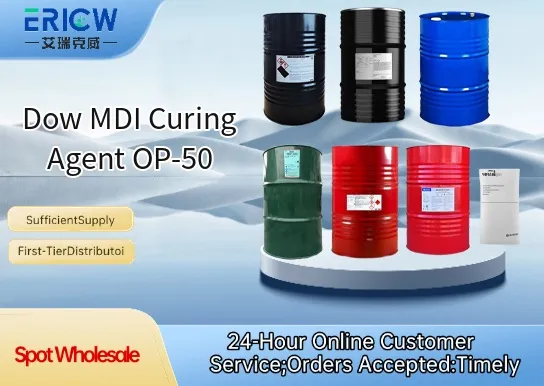
High reactivity with polyols and amines for rapid cure development.
Excellent compatibility with aromatic and aliphatic polyisocyanates in multi-component systems.
Low viscosity enables easy handling, metering, and homogeneous blending at ambient temperature.
Enhanced thermal and hydrolytic stability compared to conventional amine-based curing agents.
Enables formulation of rigid, high-crosslink-density polyurea and polyurethane coatings with superior abrasion resistance.
High-performance industrial protective coatings for steel infrastructure and pipelines.
Fast-cure elastomeric linings for containment tanks and secondary containment systems.
Rigid foam insulation systems requiring short demold times and dimensional stability.
Reaction injection molding (RIM) components for automotive and construction applications.
Adhesives and sealants demanding high bond strength and chemical resistance.
| Chemical Type | Modified MDI-based polyisocyanate curing agent |
| Product Form | Liquid |
| Appearance | Clear to pale yellow, homogeneous liquid |
| Primary Applications | Polyurea, polyurethane, and hybrid coating & elastomer systems |
| Key Features | Reactive NCO functionality, low moisture sensitivity, consistent batch-to-batch performance |
| Benefits | Reduced pot life variability, improved film integrity, enhanced adhesion to diverse substrates |
| Storage Conditions | Store in original sealed container at 15–25°C; protect from moisture and direct sunlight |
Q1: What is Dow MDI Curing Agent OP-50 primarily used for?
A: OP-50 is a polymeric methylene diphenyl diisocyanate (pMDI)-based curing agent designed to crosslink hydroxyl-functional resins—particularly polyols and polyester polyols—in high-performance thermoset systems, including rigid and flexible foams, coatings, adhesives, and elastomers.
Q2: How does OP-50 differ from conventional aromatic isocyanates like TDI or monomeric MDI?
A: OP-50 is a polymeric MDI variant with a higher average functionality and broader molecular weight distribution, offering improved blend stability, reduced volatility, and enhanced processing safety compared to monomeric isocyanates—while maintaining strong reactivity with polyols under standard curing conditions.
Q3: Is OP-50 compatible with moisture-cure or one-component polyurethane systems?
A: Yes—OP-50 can be formulated into moisture-cure systems, where it reacts with ambient moisture to form urea linkages and CO₂. However, its primary application is in two-component (2K) systems where precise stoichiometric control with polyol components enables optimal mechanical and thermal performance.
Q4: What are key handling and storage recommendations for OP-50?
A: Store in tightly sealed containers under dry, inert atmosphere (e.g., nitrogen blanket) at temperatures between 15–30 °C. Avoid prolonged exposure to moisture, heat, or strong bases. Use appropriate personal protective equipment (PPE), including chemical-resistant gloves and eye protection, as with all isocyanate-containing materials.
Q5: Can OP-50 be used in low-VOC or high-solids coating formulations?
A: Yes—OP-50’s low volatility and compatibility with high-molecular-weight polyols support the development of low-VOC and high-solids polyurethane coatings without sacrificing pot life or final film properties such as hardness, chemical resistance, and flexibility.
Contact With Us:
E-mail: wangxingqiang@ericwchem.com
Have a Questions? Call Us:
Add:
Building A1, Jiete Industrial Park, Huangpu District, Guangzhou City, Guangdong Province, China