English
 Español
 tiếng việt
 русский
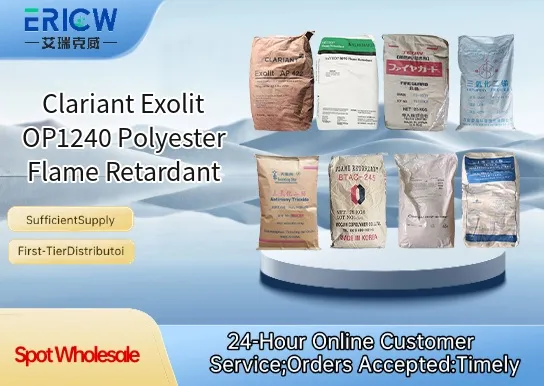
Halogen-free, phosphorus-based flame retardant specifically engineered for polyesters.
Excellent thermal stability enabling processing up to 280 °C without significant degradation.
Low volatility and minimal plate-out, ensuring consistent extrusion and injection molding performance.
Good compatibility with PET and PBT, supporting high transparency and mechanical property retention.
Enables UL 94 V-0 rating at low loading levels (typically 10–15 wt% in PET).
Electrical and electronic components requiring flame-retardant PET or PBT housings.
Automotive interior parts including connectors, sensor housings, and trim components.
Textile fibers and filaments for flame-retardant technical fabrics and upholstery.
3D printing filaments (PETG/PET-based) demanding certified fire safety performance.
Industrial conveyor belts and timing belts where heat resistance and flame retardancy are critical.
| Chemical Type | Organophosphorus compound (phosphinate-based) |
| Product Form | Fine white to off-white free-flowing powder |
| Appearance | White crystalline powder |
| Primary Applications | Polyethylene terephthalate (PET), polybutylene terephthalate (PBT) |
| Key Features | Halogen-free, RoHS-compliant, REACH registered |
| Benefits | Low smoke density, good UV stability, recyclability support |
| Density (20 °C) | ~1.5 g/cm³ (typical) |
| Decomposition Onset Temperature | ≥270 °C (TGA, 5 K/min, air) |
Q1: What is the primary application field for Exolit OP1240?
A: Exolit OP1240 is specifically developed for flame retardancy in polyester-based materials, including PET and PBT, commonly used in fibers, engineering plastics, and thin-walled injection-molded components where low smoke and halogen-free performance are required.
Q2: Is Exolit OP1240 compatible with common polyester processing methods?
A: Yes — it is designed for compatibility with standard polyester melt processing techniques, including melt compounding, extrusion, and injection molding. Its thermal stability allows for processing at typical polyester melt temperatures without significant decomposition or discoloration.
Q3: How does Exolit OP1240 achieve flame retardancy in polyester?
A: It functions primarily through a condensed-phase mechanism, promoting char formation on the polymer surface during combustion. This char layer acts as a physical barrier, reducing heat transfer and limiting fuel release — consistent with halogen-free, phosphorus-based flame retardant chemistry.
Q4: Can Exolit OP1240 be used in food-contact or regulated consumer applications?
A: While Exolit OP1240 is halogen-free and generates low smoke and low toxicity gases when burned, its suitability for food-contact or specific regulated applications depends on full formulation assessment and compliance verification by the end-user. Clariant recommends consulting local regulatory requirements and conducting appropriate migration or safety testing as part of final product qualification.
Q5: What is the typical dosage range for effective flame retardancy?
A: Effective dosage generally ranges from 0.1% to 2% by weight in polyester matrices, depending on the target flame performance (e.g., UL 94 V-0), part thickness, and presence of other additives. Optimization requires formulation-specific evaluation under actual processing and testing conditions.
Contact With Us:
E-mail: wangxingqiang@ericwchem.com
Have a Questions? Call Us:
Add:
Building A1, Jiete Industrial Park, Huangpu District, Guangzhou City, Guangdong Province, China