English
 Español
 tiếng việt
 русский
Halogen-free formulation ensuring low smoke and low toxicity during combustion.
Excellent thermal stability, maintaining performance up to 280 °C in polymer processing.
Good compatibility with polyolefins, thermoplastic elastomers (TPE), and engineering plastics.
Non-migrating design provides long-term flame-retardant efficacy and surface integrity.
Meets UL 94 V-0 rating at appropriate loading levels in standard test configurations.
Wire and cable jacketing compounds for building and infrastructure wiring.
Automotive interior components requiring flame retardancy and low corrosion potential.
Consumer electronics housings and connectors where RoHS compliance is mandatory.
Flexible PVC-free flooring and wall coverings for commercial fire-safe environments.
Thermoplastic elastomer (TPE) profiles used in public transport interiors.
| Chemical Type | Organophosphorus-based flame retardant |
| Product Form | Free-flowing white to off-white granules |
| Appearance | Granular, uniform particle size distribution |
| Density (23 °C) | 1.55–1.65 g/cm³ |
| Melting Range | 245–265 °C |
| Moisture Content | ≤ 0.2 wt% (as received) |
| RoHS Compliance | Compliant (no restricted substances above threshold) |
| Primary Applications | Polyolefins, TPEs, flexible PVC alternatives, thermoplastic polyurethanes |
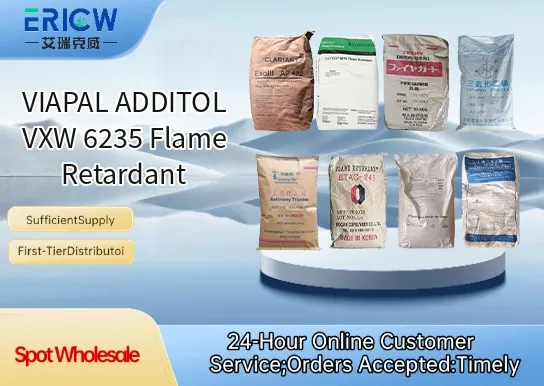
Q1: What is the primary chemical nature and functional mechanism of VIAPAL ADDITOL VXW 6235?
A: VIAPAL ADDITOL VXW 6235 is a reactive, phosphorus-based flame retardant designed for incorporation into polymer backbones—particularly polyurethanes and unsaturated polyesters. It functions primarily through condensed-phase action, promoting char formation and reducing flammable volatiles during thermal decomposition.
Q2: Is VXW 6235 compatible with common polyurethane systems, including flexible and rigid foams?
A: Yes—VXW 6235 is formulated for good compatibility with both flexible and rigid polyurethane foam systems. Its reactive functionality allows covalent integration into the polymer matrix, minimizing migration and blooming risks often associated with additive flame retardants.
Q3: How does VXW 6235 affect processing parameters and final mechanical properties?
A: When properly incorporated, VXW 6235 typically has minimal impact on processing viscosity or demold time. Mechanical performance—including tensile strength and elongation—is generally well retained, especially in formulations where it replaces part of the polyol component rather than acting as a filler.
Q4: Can VXW 6235 be used in applications requiring low smoke and low toxicity during combustion?
A: Yes—phosphorus-based chemistry contributes to reduced smoke density and lower generation of toxic carbon monoxide and aromatic compounds compared to halogenated alternatives. Performance in standardized fire tests (e.g., UL 94, LOI) reflects improved fire safety with inherently lower smoke and corrosion potential.
Q5: What are the recommended handling and storage conditions?
A: Store in original sealed containers at temperatures between 5 °C and 30 °C, protected from moisture and direct sunlight. Handle using standard industrial hygiene practices for reactive organic chemicals—ensure adequate ventilation and avoid prolonged skin contact.
Contact With Us:
E-mail: wangxingqiang@ericwchem.com
Have a Questions? Call Us:
Add:
Building A1, Jiete Industrial Park, Huangpu District, Guangzhou City, Guangdong Province, China