English
 Español
 tiếng việt
 русский
High adhesion strength to glass and various substrates, ensuring reliable interlayer bonding in laminated safety glass.
Excellent optical clarity and low haze, meeting stringent requirements for automotive and architectural glazing applications.
Superior thermal stability and consistent melt flow behavior during extrusion and calendering processes.
Optimized butyral content and molecular weight distribution for balanced toughness, flexibility, and processing efficiency.
Low volatility and minimal extractables, supporting compliance with automotive interior air quality standards (e.g., VOC/FOG).
Laminated automotive windshields and side windows.
Safety glass for architectural façades and skylights.
Photovoltaic module encapsulation layers (frontsheet interlayer).
Sound-dampening laminated glass for transportation and building acoustics.
Functional interlayers with UV-blocking or anti-shatter performance additives.
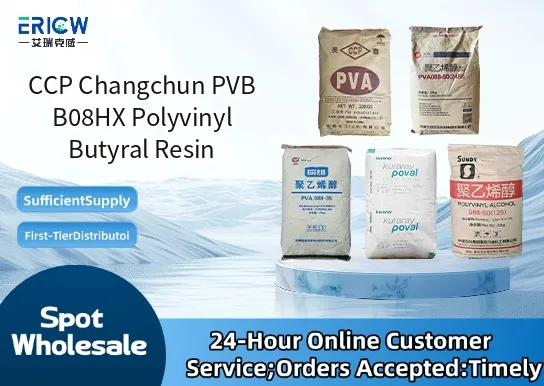
| Chemical Type | Polyvinyl butyral (PVB) resin |
| Product Form | Free-flowing granules |
| Appearance | Off-white to light yellow, uniform granules |
| Primary Applications | Laminated safety glass interlayer |
| Key Features | High adhesion, optical clarity, thermal processability |
| Benefits | Enhanced impact resistance, UV protection, dimensional stability |
| Storage Conditions | Store in cool, dry, well-ventilated area; protect from moisture and direct sunlight |
| Standard Packaging | 25 kg multi-layer paper/polyethylene bags or 500–1000 kg bulk containers |
Q1: What are the primary functional benefits of CCP Changchun PVB B08HX in adhesive and coating formulations?
A: CCP Changchun PVB B08HX offers excellent adhesion to polar substrates—including glass, metals, and treated plastics—as well as good flexibility, film-forming capability, and compatibility with a wide range of resins and plasticizers. Its balanced hydroxyl and butyral group content supports strong interfacial bonding while maintaining workable viscosity and drying characteristics.
Q2: How does B08HX differ from standard PVB resins used in laminated safety glass?
A: Unlike high-molecular-weight PVB grades optimized for structural interlayers in architectural or automotive laminated glass, B08HX is engineered for non-structural applications—particularly as a binder or modifier in specialty adhesives, overprint varnishes, and protective coatings. It features a lower average molecular weight and tailored solubility profile for enhanced processability in solvent-based and hybrid systems.
Q3: Is B08HX suitable for use in food-contact coatings or inks?
A: B08HX is not pre-approved for direct food-contact applications. While polyvinyl butyral resins are generally recognized as low-risk in certain indirect contact scenarios, suitability for food-contact use depends on full formulation compliance, regulatory evaluation, and final application conditions. Customers must conduct their own due diligence and consult applicable regional regulations before use in such contexts.
Q4: What solvents are recommended for dissolving B08HX effectively?
A: B08HX demonstrates good solubility in common organic solvents such as ethanol, isopropanol, n-butanol, ethyl acetate, and ketones (e.g., MEK, acetone). It is only partially soluble in aromatic hydrocarbons and aliphatic solvents, and incompatible with water. Optimal dissolution typically requires moderate agitation and may benefit from slight warming (<50 °C) depending on concentration and solvent blend.
Contact With Us:
E-mail: wangxingqiang@ericwchem.com
Have a Questions? Call Us:
Add:
Building A1, Jiete Industrial Park, Huangpu District, Guangzhou City, Guangdong Province, China