English
 Español
 tiếng việt
 русский
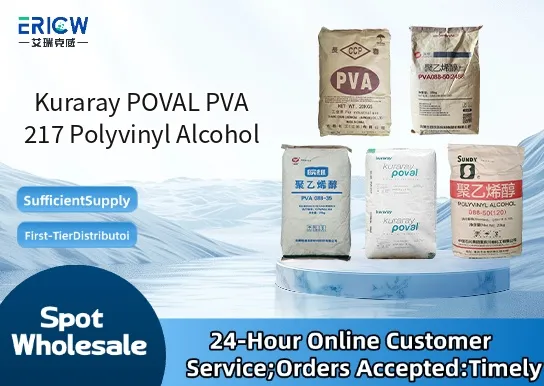
High water solubility with rapid dissolution in cold and warm water.
Excellent film-forming capability yielding strong, flexible, and transparent films.
Good adhesion to polar substrates including paper, wood, and metal surfaces.
Biodegradable and non-toxic, supporting sustainable manufacturing practices.
Consistent batch-to-batch quality due to Kuraray’s proprietary saponification control.
Water-soluble packaging films for agrochemicals and detergent pods.
Binders in ceramic and refractory green bodies for improved dry strength.
Thickener and stabilizer in water-based paints and coatings.
Protective colloid in emulsion polymerization of vinyl acetate and acrylic monomers.
Adhesive component in laminating adhesives for flexible food packaging.
| Chemical Type | Polyvinyl alcohol (partially hydrolyzed) |
| Product Form | White granular powder |
| Appearance | Free-flowing, odorless white granules |
| Saponification Degree | 87–89 mol% |
| Viscosity (4% aqueous solution at 20°C) | 20–23 mPa·s |
| Residual Acetate Content | ≤11.5 wt% |
| pH (1% aqueous solution) | 5.0–6.5 |
| Moisture Content | ≤5.0 wt% |
Q1: What is the primary functional advantage of POVAL PVA 217 compared to other polyvinyl alcohol grades?
A: POVAL PVA 217 offers a balanced combination of medium molecular weight and partial hydrolysis, resulting in excellent film-forming capability, good water solubility at moderate temperatures, and strong adhesion to polar substrates—making it especially suitable for binder and coating applications where cohesive strength and controlled dissolution rate are critical.
Q2: Is POVAL PVA 217 compatible with common industrial surfactants and rheology modifiers?
A: Yes, POVAL PVA 217 generally exhibits good compatibility with nonionic and anionic surfactants, as well as associative thickeners and cellulose derivatives. However, formulation stability should be verified experimentally, particularly when used with highly cationic additives or under high-salt conditions.
Q3: How should POVAL PVA 217 be dissolved for optimal performance in aqueous systems?
A: For best results, gradually disperse the powder into cold water with vigorous agitation to prevent agglomeration, then heat gently to 85–95 °C while maintaining stirring until fully dissolved and clear. Avoid prolonged heating above 95 °C to minimize potential chain degradation.
Q4: Can POVAL PVA 217 be used in applications requiring thermal resistance after film formation?
A: While pure PVA films have limited thermal stability above 150 °C, POVAL PVA 217-based films can achieve improved heat resistance through crosslinking (e.g., with aldehydes or boric acid) or blending with thermally stable polymers—commonly applied in foundry binders and specialty paper coatings.
Contact With Us:
E-mail: wangxingqiang@ericwchem.com
Have a Questions? Call Us:
Add:
Building A1, Jiete Industrial Park, Huangpu District, Guangzhou City, Guangdong Province, China