English
 Español
 tiếng việt
 русский
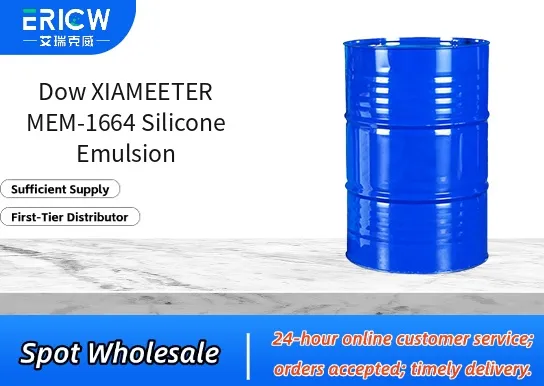
Highly stable anionic silicone emulsion with excellent shelf life and freeze-thaw resistance.
Delivers superior softness, smoothness, and hydrophobicity to treated substrates.
Compatible with common textile auxiliaries and exhibits good mixing stability in formulation systems.
Low foaming profile suitable for continuous processing applications such as padding and exhaust.
Provides durable water repellency without compromising fabric breathability or hand feel.
Textile finishing for cotton, polyester, and blended fabrics.
Nonwoven fabric treatment to enhance softness and drape.
Leather surface conditioning for improved suppleness and water resistance.
Paper coating additive for moisture barrier enhancement and surface smoothness.
Industrial cleaning formulations requiring silicone-based surface modification.
| Chemical Type | Dimethicone-based anionic silicone emulsion |
| Product Form | Aqueous emulsion |
| Appearance | Opaque white to off-white liquid |
| pH (1% aqueous solution) | 5.5 – 7.0 |
| Active Content | 30 ± 1 wt% |
| Viscosity (25°C, Brookfield LVT, Spindle #3, 6 rpm) | 100 – 300 cP |
| Particle Size (D50) | 0.2 – 0.5 µm |
| Storage Stability | Stable for ≥ 12 months at 5–30°C in sealed container |
Q1: What is the primary function of MEM-1664 in industrial coatings and inks?
A: MEM-1664 is a non-ionic, anionic-stabilized silicone emulsion designed to provide surface leveling, substrate wetting, and foam control in water-based systems. It helps reduce surface defects such as craters, orange peel, and pinholes while improving gloss uniformity and substrate adhesion.
Q2: Is MEM-1664 compatible with common water-based polymer systems like acrylics, vinyl acetate, and styrene-butadiene dispersions?
A: Yes, MEM-1664 demonstrates broad compatibility with many anionic and non-ionic aqueous polymer dispersions. It is typically added during the let-down stage and remains stable under standard formulation pH conditions (pH 6–9), though compatibility testing under specific shear, temperature, and ionic strength conditions is recommended.
Q3: How should MEM-1664 be incorporated into a formulation to ensure optimal performance?
A: For best results, MEM-1664 should be added gradually with gentle mixing—avoid high-shear dispersion unless validated for the target system. Pre-dilution with water or a compatible co-solvent may aid incorporation. Dosage depends on formulation requirements but generally ranges from 0.1% to 2% by weight of the total formulation.
Q4: Does MEM-1664 contribute to long-term storage stability of formulated products?
A: MEM-1664 is formulated to support colloidal stability in typical water-based systems when used within recommended dosage ranges and pH windows. However, long-term stability can be influenced by other formulation components (e.g., biocides, surfactants, electrolytes), so accelerated storage testing under intended conditions is advised.
Contact With Us:
E-mail: wangxingqiang@ericwchem.com
Have a Questions? Call Us:
Add:
Building A1, Jiete Industrial Park, Huangpu District, Guangzhou City, Guangdong Province, China