English
 Español
 tiếng việt
 русский
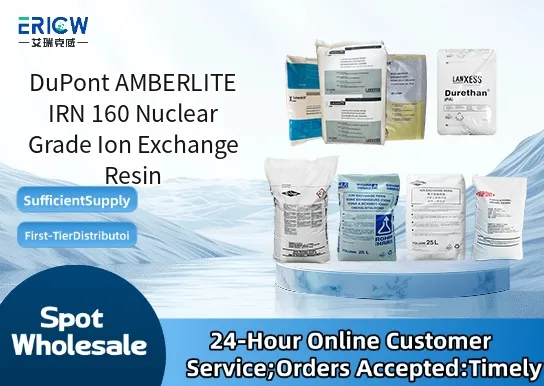
Manufactured to stringent nuclear-grade quality standards compliant with ASTM D2187 and EPRI guidelines for reactor coolant purification.
Exceptional chemical and thermal stability in high-purity, low-conductivity water systems typical of nuclear power plant service.
Ultra-low total organic carbon (TOC) extractables to prevent contamination of primary and secondary coolant loops.
Consistent spherical bead morphology with tight particle size distribution for uniform hydraulic performance and minimal pressure drop.
Optimized for high-efficiency removal of cobalt-60, cesium-137, and other fission/activation products in condensate polishing applications.
Condensate polishing in pressurized water reactors (PWRs) and boiling water reactors (BWRs).
Purification of reactor makeup water and auxiliary system feedwater.
Service in mixed-bed ion exchange units for ultra-high-purity steam generator feedwater.
Decontamination of spent fuel pool water and auxiliary cooling circuits.
Final polishing step in nuclear-grade ultrapure water (UPW) production systems.
| Chemical Type | Strong acid cation exchange resin (sulfonated polystyrene-divinylbenzene) |
| Product Form | Moist, spherical beads |
| Appearance | Amber-colored, translucent beads |
| Functional Group | Sulfonic acid (–SO₃H) |
| Ion Form | H⁺ form (ready for use) |
| Moisture Content | 45–50% (as shipped) |
| Uniformity Coefficient | ≤ 1.3 |
| Maximum Operating Temperature | 120 °C (248 °F) |
Q1: What distinguishes IRN 160 from standard-grade ion exchange resins?
A: IRN 160 is specifically manufactured and tested to meet stringent nuclear industry requirements, including ultra-low levels of leachable metals, enhanced radiation stability, and strict quality control for trace impurities—ensuring reliable performance in critical primary coolant purification and spent fuel pool water treatment applications.
Q2: Is IRN 160 suitable for use in pressurized water reactor (PWR) primary coolant systems?
A: Yes—IRN 160 is widely specified for PWR primary coolant polishing due to its high selectivity for corrosion product cations (e.g., cobalt, iron, nickel), low pressure drop characteristics in mixed-bed configurations, and proven compatibility with high-purity, high-temperature, low-conductivity water environments.
Q3: How does IRN 160 perform under prolonged gamma irradiation exposure?
A: As a nuclear-grade resin, IRN 160 is formulated with radiation-resistant functional groups and matrix crosslinking to maintain structural integrity and ion exchange capacity over extended service life in high-radiation zones—though actual performance depends on cumulative dose, temperature, and operational cycling conditions.
Q4: Can IRN 160 be regenerated in situ, and what are the typical regeneration protocols?
A: IRN 160 is designed for conventional acid–base regeneration in mixed-bed or separate-bed configurations. Regeneration typically employs high-purity hydrochloric acid and sodium hydroxide solutions, with careful attention to rinse efficiency and conductivity endpoints to ensure minimal residual regenerant and optimal deionization performance.
Contact With Us:
E-mail: wangxingqiang@ericwchem.com
Have a Questions? Call Us:
Add:
Building A1, Jiete Industrial Park, Huangpu District, Guangzhou City, Guangdong Province, China