English
 Español
 tiếng việt
 русский
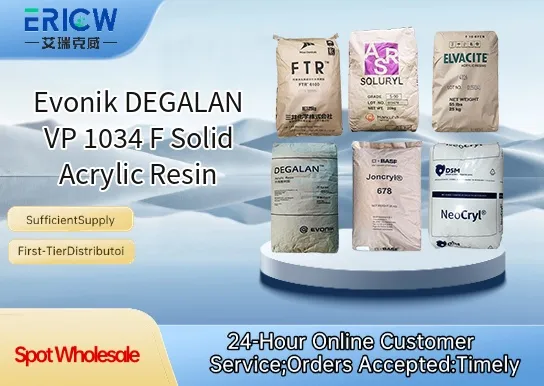
High molecular weight solid acrylic resin offering excellent film hardness and scratch resistance.
Designed for solvent-based coatings systems with good solubility in common organic solvents (e.g., xylene, toluene, esters).
Provides outstanding gloss retention and UV stability in exterior applications.
Enables formulation of high-solids, low-VOC coatings without compromising flow and leveling.
Consistent batch-to-batch reproducibility supported by Evonik’s stringent quality control.
Automotive refinish clearcoats and basecoats.
Industrial maintenance coatings for metal and plastic substrates.
High-performance coil coatings requiring durability and weatherability.
Powder coating modifiers and hybrid binder components.
General-purpose decorative and protective solventborne topcoats.
| Chemical Type | Solid acrylic copolymer |
| Product Form | Free-flowing white to off-white granules |
| Appearance | Granular solid, homogeneous |
| Primary Applications | Solventborne industrial and automotive coatings |
| Key Features | High hardness, UV stability, good solubility, low yellowing |
| Benefits | Enhanced durability, gloss retention, formulation flexibility |
| Storage Conditions | Store in cool, dry place; protect from moisture and direct sunlight |
| Regulatory Compliance | REACH compliant;不含 intentionally added SVHCs above threshold |
Q1: What is the primary function of DEGALAN VP 1034 F in coating formulations?
A: DEGALAN VP 1034 F is a solid acrylic resin designed primarily as a rheology modifier and matting agent in solventborne and high-solids coatings. It helps control viscosity, improve sag resistance, and deliver consistent, uniform surface mattness without significantly compromising clarity or film integrity.
Q2: Is DEGALAN VP 1034 F compatible with common crosslinkers used in industrial baking enamels?
A: Yes — it demonstrates good compatibility with melamine-formaldehyde and urea-formaldehyde resins, as well as with polyisocyanate curing agents in two-component polyurethane systems. Compatibility should always be verified under actual formulation conditions, including solvent blend and cure schedule.
Q3: How is DEGALAN VP 1034 F typically incorporated into a coating system?
A: It is generally added during the let-down or post-addition stage, dispersed using high-shear mixing in suitable solvents such as xylene, butyl acetate, or aromatic blends. Pre-wetting or gradual addition helps avoid agglomeration and ensures uniform distribution throughout the formulation.
Q4: Does DEGALAN VP 1034 F affect the gloss level of cured films?
A: Yes — it is specifically engineered to reduce surface gloss and produce stable matte finishes. The degree of gloss reduction depends on particle size distribution, concentration, and film thickness, but consistent low-gloss performance is achieved across typical application ranges.
Q5: Can DEGALAN VP 1034 F be used in food-contact compliant coating systems?
A: While DEGALAN VP 1034 F is not inherently restricted for food-contact use, final regulatory compliance depends on the full formulation, processing conditions, and intended application. Formulators must conduct full migration testing and verify conformity with applicable regional regulations before claiming food-contact suitability.
Contact With Us:
E-mail: wangxingqiang@ericwchem.com
Have a Questions? Call Us:
Add:
Building A1, Jiete Industrial Park, Huangpu District, Guangzhou City, Guangdong Province, China