English
 Español
 tiếng việt
 русский
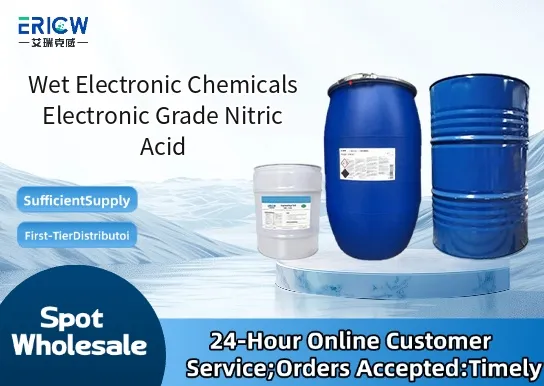
Ultra-low metallic impurity levels (<1 ppt for key cations including Fe, Cu, Ni, Cr, and Al).
Exceptionally low particulate count (<1 particle/mL @ ≥0.1 µm, measured per SEMI F57).
Controlled anionic impurities (Cl⁻, SO₄²⁻, PO₄³⁻ < 10 ppt) to prevent residue formation and device corrosion.
Stabilized formulation with ultra-high purity quartz or fluoropolymer packaging to minimize leachables.
Consistent batch-to-batch reproducibility certified via ICP-MS, IC, and light scattering analysis.
Front-end-of-line (FEOL) silicon wafer cleaning prior to gate oxide growth.
Post-etch residue removal for aluminum and titanium-based metallization layers.
Photoresist stripping in advanced logic and memory fabrication (28 nm and below).
Surface passivation and native oxide control during MEMS and power device processing.
Pre-diffusion cleaning for high-voltage semiconductor substrates.
| Chemical Type | Nitric Acid (HNO₃), electronic grade |
| Product Form | Liquid, aqueous solution (typically 69–70 wt% HNO₃) |
| Appearance | Clear, colorless to pale yellow liquid; no visible haze or particles |
| Primary Applications | Wafer cleaning, metal etch residue removal, photoresist ashing aid |
| Key Features | Low metals, low anions, low organics, low particles, high stability |
| Benefits | Minimizes defect density, prevents interlayer contamination, extends tool uptime |
| Regulatory Compliance | SEMI C1–C12, SEMI F57, RoHS 3 Directive (2015/863/EU), REACH SVHC-free |
| Packaging | High-purity fluoropolymer (FEP/PFA) bottles or quartz-lined drums (1L–200L) |
| Common Compatible Systems | Suitability |
| Single-wafer spin-rinse-dry (SRD) tools (e.g., Tokyo Electron ACTRA®, Lam Research SPIN) | Highly Recommended – Optimized for low-flow, high-precision delivery and minimal reagent carryover |
| Batch immersion wet benches (e.g., SCREEN SSW series, KLA-Tencor AURA) | Recommended – Requires temperature-controlled circulation and dedicated filtration (0.02 µm PTFE) |
| Inline spray-type cleaners (e.g., DISCO DFL7340, Axcelis IMPULSE) | Suitable – Compatible with stainless-steel and fluoropolymer fluid paths when properly passivated |
| Automated chemical dispensing systems (e.g., Entegris Cygnet™, VeeGee ChemiQ) | Highly Recommended – Certified for use with ultra-low outgassing and electrostatic discharge (ESD)-safe protocols |
Q1: What is the CAS Registry Number for electronic grade nitric acid?
A: The CAS number is 7697-37-2. Our electronic grade material conforms strictly to this identity and is verified by FTIR and Raman spectroscopy per SEMI C37.
Q2: How does usage concentration affect etch selectivity in aluminum metallization processes?
A: At 69–70 wt%, it delivers optimal Al:SiO₂ selectivity (>150:1) with minimal silicon substrate attack. Dilution below 65 wt% increases silicon undercut; undiluted handling requires strict thermal control to avoid NOₓ off-gassing.
Q3: How does this product compare to semiconductor-grade nitric acid from other suppliers?
A: Unlike standard semiconductor grades, our electronic grade undergoes triple sub-boiling distillation under Class 1 cleanroom conditions, followed by 0.02 µm final filtration and real-time particle monitoring — achieving >10× lower Na⁺/K⁺ and consistent Cl⁻ < 5 ppt.
Q4: Is migration testing data available for use in EU and U.S. fab environments?
A: Yes. Migration studies per SEMI F71 show extractables < 0.1 ng/cm² for FEP containers after 72h at 25°C, with full compliance to IEC 60747-17 (semiconductor device cleanliness) and U.S. FDA 21 CFR 177.1520 for incidental contact.
Q5: Does this nitric acid require special ventilation or handling beyond standard fuming acid protocols?
A: Yes. Due to ultra-low impurity specifications, exposure to ambient air must be minimized: use inert gas blanketing (N₂ or Ar) during dispensing, and maintain dew point ≤ −40°C in delivery lines to prevent moisture-induced particulation.
Contact With Us:
E-mail: wangxingqiang@ericwchem.com
Have a Questions? Call Us:
Add:
Building A1, Jiete Industrial Park, Huangpu District, Guangzhou City, Guangdong Province, China