English
 Español
 tiếng việt
 русский
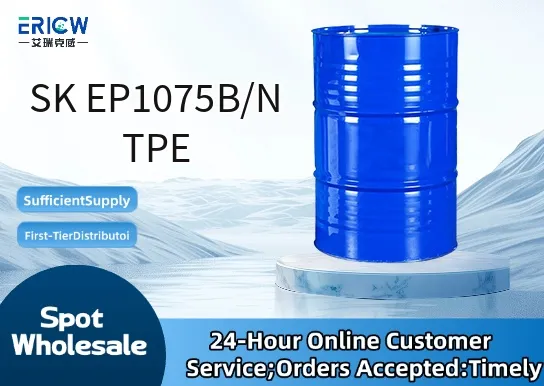
High elasticity and excellent rebound resilience for dynamic sealing applications.
Good processability via injection molding and extrusion without pre-drying.
Outstanding soft-touch feel with skin-friendly surface characteristics.
Enhanced thermal stability up to 130 °C short-term exposure.
Low extractables and compliance with FDA 21 CFR §177.2600 for food-contact-adjacent use.
Soft-grip overmolding for power tools and handheld appliances.
Sealing rings and gaskets in automotive fluid systems.
Medical device components requiring biocompatibility and sterilizability.
Consumer electronics casings and protective covers.
Food-grade appliance seals and dispensing nozzles.
| Chemical Type | Thermoplastic Elastomer (TPE) — Styrenic Block Copolymer (SEBS-based) |
| Product Form | Pellets |
| Appearance | Opaque off-white granules |
| Hardness (Shore A, ASTM D2240) | 75 ± 3 |
| Melt Flow Rate (230 °C/2.16 kg, ASTM D1238) | 18–22 g/10 min |
| Density (ASTM D792) | 0.98–1.01 g/cm³ |
| Tensile Strength (ASTM D412) | 12–14 MPa |
| Elongation at Break (ASTM D412) | ≥ 450 % |
Q1: What is the primary function of SK EP1075B/N TPE in thermoplastic elastomer formulations?
A: SK EP1075B/N TPE functions as a high-performance processing aid and compatibilizer, enhancing melt flow, reducing viscosity during extrusion or injection molding, and improving dispersion of fillers or additives in TPE blends.
Q2: Is SK EP1075B/N TPE compatible with common TPE base polymers such as SEBS, TPO, and TPV?
A: Yes — SK EP1075B/N TPE is specifically engineered for compatibility with styrenic block copolymers (e.g., SEBS), polyolefin-based TPEs (e.g., TPO), and dynamically vulcanized alloys (TPV), supporting stable phase morphology and mechanical integrity in multi-component systems.
Q3: How does SK EP1075B/N TPE affect the final product’s surface appearance and tactile properties?
A: It contributes to improved surface smoothness and reduced die build-up, often resulting in glossier, more uniform finishes. Its low-migration character helps maintain consistent soft-touch feel without bloom or tackiness under typical processing and service conditions.
Q4: Can SK EP1075B/N TPE be used in applications requiring regulatory compliance for food contact or skin contact?
A: SK EP1075B/N TPE is formulated without intentionally added heavy metals, phthalates, or primary aromatic amines. While it is not pre-certified for specific regulatory frameworks, its composition supports formulation development for food-contact and skin-contact applications — final compliance depends on full system validation by the end-user.
Contact With Us:
E-mail: wangxingqiang@ericwchem.com
Have a Questions? Call Us:
Add:
Building A1, Jiete Industrial Park, Huangpu District, Guangzhou City, Guangdong Province, China