English
 Español
 tiếng việt
 русский
Excellent abrasion resistance for extended service life in demanding mechanical environments.
High tensile strength and elongation at break, enabling superior flexibility and load-bearing performance.
Good processability via extrusion, injection molding, and calendering with minimal thermal degradation.
Outstanding low-temperature flexibility down to –40 °C without significant loss of elasticity.
Hydrolysis-resistant formulation suitable for humid or wet-condition applications.
Industrial hoses and pneumatic tubing requiring high pressure resistance and kink recovery.
Roller covers and conveyor belts exposed to abrasive particulates and continuous flexing.
Automotive interior trim components including soft-touch overlays and gaskets.
Footwear midsoles and outsoles where energy return and wear durability are critical.
Medical device tubing and seals compliant with ISO 10993 biocompatibility screening requirements.
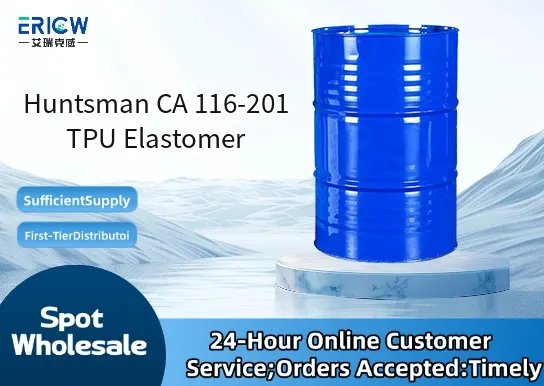
| Chemical Type | Aliphatic polyester-based thermoplastic polyurethane (TPU) |
| Product Form | Pellets |
| Appearance | Off-white to light tan, free-flowing granules |
| Primary Applications | Extruded profiles, molded parts, coated fabrics, and flexible industrial components |
| Key Features | Abrasion resistance, hydrolytic stability, low-temperature flexibility, melt-processable |
| Benefits | Reduced maintenance frequency, extended product lifetime, design freedom for complex geometries |
| Processing Method | Extrusion, injection molding, blow molding, calendering |
| Storage Conditions | Store in dry, cool conditions (<25 °C); desiccate prior to processing if exposed to ambient humidity |
Q1: What is the primary function of CA 116-201 in TPU formulations?
A: CA 116-201 is a chain extender specifically designed for thermoplastic polyurethane (TPU) systems. It reacts with isocyanate-terminated prepolymers to build molecular weight, enhance mechanical strength, and improve melt processability—particularly in extrusion and injection molding applications.
Q2: Is CA 116-201 compatible with aromatic and aliphatic TPU systems?
A: Yes, CA 116-201 demonstrates broad compatibility across both aromatic and aliphatic TPU chemistries. Its reactivity profile allows effective chain extension without excessive gelation or discoloration, supporting consistent processing and final part performance in diverse base polymer systems.
Q3: How does CA 116-201 compare to conventional diamine chain extenders in terms of processing safety?
A: Unlike highly reactive aromatic diamines, CA 116-201 offers a more controlled reaction profile with reduced sensitivity to moisture and lower volatility. This contributes to improved handling safety, extended pot life during compounding, and greater consistency in high-speed melt processing operations.
Q4: Can CA 116-201 be used in medical-grade or food-contact TPU applications?
A: CA 116-201 is not inherently certified for medical or food-contact use. Its suitability for such applications depends on full system validation—including final compound testing, regulatory review, and compliance with applicable regional requirements. Customers must conduct thorough end-use qualification before deployment in regulated markets.
Contact With Us:
E-mail: wangxingqiang@ericwchem.com
Have a Questions? Call Us:
Add:
Building A1, Jiete Industrial Park, Huangpu District, Guangzhou City, Guangdong Province, China