English
 Español
 tiếng việt
 русский
Excellent balance of thermoplastic processability and elastomeric performance
High tensile strength and exceptional fatigue resistance
Outstanding resistance to oils, greases, and many common chemicals
Broad service temperature range from –40 °C to +150 °C (short-term)
Good UV and weathering stability with inherent hydrolytic resistance
Automotive under-hood components including air ducts and sensor housings
Industrial power transmission belts and timing belt covers
Consumer appliance parts requiring dynamic flexibility and heat resistance
Oil and gas downhole tool components exposed to harsh fluids
Medical device tubing and seals requiring biocompatibility support (ISO 10993 tested)
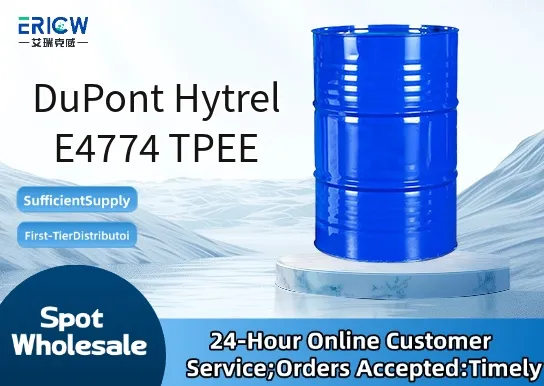
| Chemical Type | Thermoplastic polyester elastomer (TPEE) |
| Product Form | Pellets |
| Appearance | Off-white to light tan, free-flowing pellets |
| Primary Applications | Dynamic mechanical parts, fluid-handling components, high-cycle flex applications |
| Key Features | High modulus, excellent creep resistance, low compression set |
| Benefits | Reduced part count vs. multi-material assemblies; enables overmolding onto PP, PC, and ABS |
| Processing Method | Injection molding, extrusion, blow molding |
| Regulatory Compliance | Meets FDA 21 CFR §177.2400 for food-contact applications (when processed per guidelines) |
Q1: What are the key performance advantages of Hytrel E4774 compared to standard TPEEs?
A: Hytrel E4774 is a high-flow, medium-hardness thermoplastic elastomer engineered for enhanced processability in thin-wall and complex geometries. It offers an optimized balance of melt fluidity, tensile strength, and recovery resilience—making it especially suitable for injection-molded components requiring consistent dimensional stability and dynamic fatigue resistance.
Q2: Is Hytrel E4774 compatible with common engineering plastics for co-injection or overmolding?
A: Yes, Hytrel E4774 exhibits good adhesion to many semi-crystalline and amorphous thermoplastics—including polypropylene, ABS, and certain nylons—when processed under appropriate temperature and mold surface conditions. Bond strength depends on interfacial compatibility, melt temperature alignment, and part design, and is typically validated through application-specific testing.
Q3: How should Hytrel E4774 be dried prior to processing?
A: Like most TPEEs, Hytrel E4774 is hygroscopic and must be thoroughly dried before processing. Recommended drying conditions are 4–6 hours at 120 °C in a desiccant dryer, with moisture content maintained below 50 ppm to prevent hydrolytic degradation and surface defects during molding.
Q4: Can Hytrel E4774 be used in applications requiring repeated flexing or cyclic loading?
A: Yes—Hytrel E4774 retains excellent elastic recovery and low permanent set after repeated deformation, making it well-suited for dynamic components such as bellows, hinges, and flexible couplings where long-term mechanical integrity under cyclic stress is critical.
Contact With Us:
E-mail: wangxingqiang@ericwchem.com
Have a Questions? Call Us:
Add:
Building A1, Jiete Industrial Park, Huangpu District, Guangzhou City, Guangdong Province, China