English
 Español
 tiếng việt
 русский
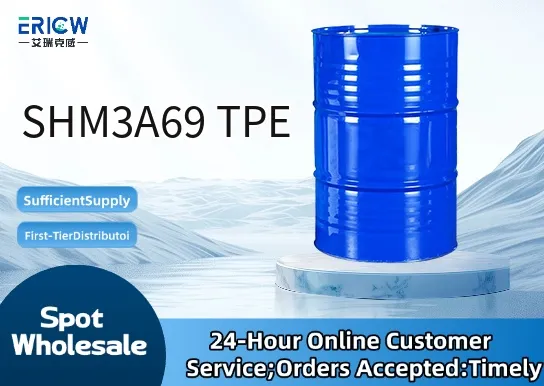
Excellent soft-touch feel with balanced hardness (Shore A 69) for ergonomic handling.
Superior adhesion to polypropylene (PP), polyethylene (PE), and ABS substrates without primer.
Good thermal stability for injection molding and extrusion processing at standard TPE temperature ranges.
Low extractables and compliant with FDA 21 CFR §177.2600 for food-contact-adjacent applications.
Recyclable within TPE waste streams and free of halogens, phthalates, and heavy metals.
Overmolded grips for power tools and handheld appliances.
Sealing rings and gaskets in automotive fluid systems.
Soft-touch control buttons and interface components in medical devices.
Flexible hinges and snap-fit closures in consumer electronics housings.
Non-slip surfaces for sports equipment and fitness accessories.
| Chemical Type | Thermoplastic Elastomer (TPE), Styrenic Block Copolymer (SBC)-based |
| Product Form | Pellets |
| Appearance | Translucent beige granules |
| Hardness (Shore A) | 69 ± 2 |
| Melt Flow Rate (200°C/5 kg) | 18–22 g/10 min |
| Density | 0.92 g/cm³ |
| Key Features | Soft-touch, substrate adhesion, processability, low volatility |
| Compliance | RoHS 2011/65/EU, REACH SVHC-free, FDA-compliant (indirect contact) |
Q1: What is SHM3A69 TPE primarily used for?
A: SHM3A69 TPE is a thermoplastic elastomer designed for soft-touch overmolding and functional sealing applications, especially where resilience, flexibility, and processability on standard injection molding equipment are required.
Q2: Is SHM3A69 TPE compatible with common engineering plastics like PP, ABS, or PC?
A: Yes — SHM3A69 TPE exhibits good adhesion to polypropylene (PP) and ABS substrates without requiring primers or surface treatment under optimized processing conditions; compatibility with polycarbonate (PC) may require evaluation of interfacial bonding and thermal stability during co-processing.
Q3: What are the recommended drying and processing conditions?
A: SHM3A69 TPE should be dried at 60–70 °C for 2–4 hours prior to processing; melt temperature typically ranges from 170 °C to 210 °C, and mold temperatures between 20 °C and 40 °C are generally suitable for balanced cycle time and surface quality.
Q4: Does SHM3A69 TPE meet regulatory requirements for food contact or skin-contact applications?
A: SHM3A69 TPE is formulated without intentionally added heavy metals, phthalates, or primary aromatic amines; compliance with specific food contact or medical device regulations depends on final formulation, processing history, and end-use conditions — users are advised to conduct application-specific testing and consult local regulatory guidance.
Contact With Us:
E-mail: wangxingqiang@ericwchem.com
Have a Questions? Call Us:
Add:
Building A1, Jiete Industrial Park, Huangpu District, Guangzhou City, Guangdong Province, China