English
 Español
 tiếng việt
 русский
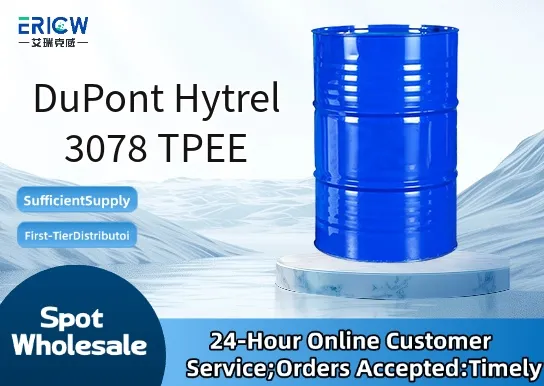
Excellent balance of thermoplastic processability and elastomeric performance.
High resistance to flex fatigue and dynamic stress under repeated bending.
Good chemical resistance to oils, greases, and many automotive fluids.
Retains mechanical properties across a wide temperature range (–40 °C to 150 °C short-term).
Outstanding creep resistance compared to conventional TPEs and soft thermoplastics.
Automotive air ducts and HVAC components requiring dimensional stability and vibration damping.
Fuel system components including quick-connect couplings and fuel line retainers.
Power tool housings and ergonomic overmolded grips demanding impact resilience and tactile feel.
Industrial hose covers and bellows exposed to cyclic flexing and environmental stress.
Consumer appliance parts such as dishwasher pump housings and washing machine door seals.
| Chemical Type | Thermoplastic Polyester Elastomer (TPEE) |
| Product Form | Pellets |
| Appearance | Off-white to light tan, semi-crystalline granules |
| Primary Applications | Dynamic structural components requiring fatigue resistance and thermal stability |
| Key Features | High modulus, low compression set, excellent rebound resilience |
| Processing Method | Injection molding, extrusion, blow molding |
| Density (ASTM D792) | 1.16 g/cm³ |
| Melt Flow Rate (230 °C/2.16 kg, ASTM D1238) | 15 g/10 min |
Q1: What are the key mechanical advantages of Hytrel 3078 compared to other TPEEs or thermoplastic elastomers?
A: Hytrel 3078 offers an excellent balance of high tensile strength, outstanding flex fatigue resistance, and good low-temperature toughness—making it particularly suitable for dynamic, repetitive-motion applications such as bellows, couplings, and flexible shaft covers. Its polyester-based chemistry provides superior creep resistance and dimensional stability under sustained load versus many styrenic or olefinic TPEs.
Q2: Is Hytrel 3078 compatible with common engineering plastics for co-injection or overmolding?
A: Yes, Hytrel 3078 exhibits good adhesion to polypropylene, ABS, and certain grades of polycarbonate when processed under optimized temperature and mold surface conditions. For best bonding performance, substrate drying, melt temperature control, and interfacial residence time should be carefully evaluated during process development.
Q3: How does Hytrel 3078 perform in environments exposed to oils, greases, and common industrial fluids?
A: As a polyester-based TPEE, Hytrel 3078 demonstrates good resistance to non-polar oils and greases, as well as many hydraulic fluids and aliphatic hydrocarbons. However, prolonged exposure to strong polar solvents (e.g., ketones, chlorinated hydrocarbons) or hot acidic/basic media may lead to swelling or degradation—compatibility testing under actual service conditions is recommended.
Q4: Can Hytrel 3078 be used in applications requiring repeated sterilization?
A: Hytrel 3078 retains functional properties after multiple cycles of steam autoclaving (e.g., 121°C, 20 min) and gamma irradiation (up to typical medical device doses), though long-term performance depends on part geometry, stress state, and cumulative dose. It is not intended for repeated high-pressure steam exposure above 134°C without validation.
Contact With Us:
E-mail: wangxingqiang@ericwchem.com
Have a Questions? Call Us:
Add:
Building A1, Jiete Industrial Park, Huangpu District, Guangzhou City, Guangdong Province, China