English
 Español
 tiếng việt
 русский
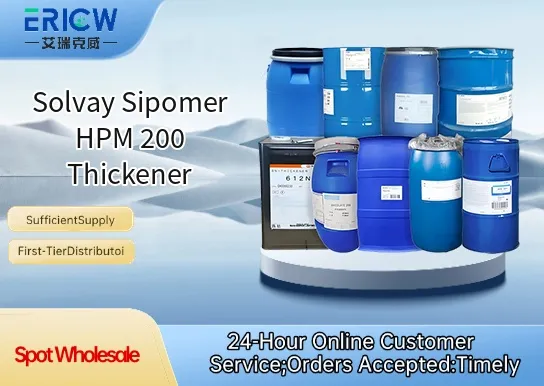
High-efficiency associative thickener based on hydrophobically modified polyacrylate chemistry.
Delivers excellent rheology control and viscosity stability across a broad pH range (pH 3–12).
Provides outstanding shear-thinning behavior and sag resistance in formulated systems.
Compatible with anionic, nonionic, and amphoteric surfactants, as well as common preservatives and electrolytes.
Enables low-odor, low-VOC formulations without compromising performance or shelf life.
Architectural coatings including interior and exterior latex paints.
Industrial maintenance coatings and protective finishes.
Printing inks—especially water-based flexographic and gravure inks.
Agrochemical suspensions and sprayable formulations.
Home care products such as liquid detergents and all-purpose cleaners.
| Chemical Type | Hydrophobically Modified Polyacrylate (HMPA) |
| Product Form | Aqueous dispersion (approx. 25% active content) |
| Appearance | Opaque white to off-white liquid |
| pH (1% aqueous solution) | 3.0 – 5.0 |
| Viscosity (Brookfield, spindle #3, 20 rpm, 25°C) | 500 – 2,500 mPa·s |
| Free Monomer Content | < 100 ppm acrylic acid |
| Primary Applications | Waterborne coatings, inks, and cleaning formulations |
| Key Features | Non-ionic associative thickening, low foaming, easy incorporation |
Q1: What type of rheology does Sipomer HPM 200 deliver in aqueous systems?
A: Sipomer HPM 200 is an associative thickener that provides shear-thinning behavior and enhances mid-shear viscosity, supporting good flow control, sag resistance, and brush/roller application performance in waterborne coatings and construction formulations.
Q2: Is Sipomer HPM 200 compatible with common surfactants and co-thickeners used in architectural paints?
A: Yes — it exhibits broad compatibility with nonionic and anionic surfactants, as well as with cellulosic thickeners and other associative types. However, optimal performance requires careful sequencing during formulation and may benefit from pH adjustment to the recommended range (typically 7.5–9.5) prior to addition.
Q3: How should Sipomer HPM 200 be incorporated into a formulation to ensure consistent thickening?
A: It is recommended to pre-dilute the product with water or a compatible solvent before gradual addition under moderate agitation. Direct addition of the undiluted concentrate may lead to localized overdosing and inconsistent dispersion. Allow sufficient time for full hydration and structure development post-addition.
Q4: Does Sipomer HPM 200 offer stability benefits in freeze-thaw cycling?
A: While not specifically designed as a freeze-thaw stabilizer, Sipomer HPM 200 contributes to improved formulation robustness when used in conjunction with appropriate stabilizers. Its associative network helps maintain viscosity recovery after thawing, though full freeze-thaw stability depends on the overall system design.
Contact With Us:
E-mail: wangxingqiang@ericwchem.com
Have a Questions? Call Us:
Add:
Building A1, Jiete Industrial Park, Huangpu District, Guangzhou City, Guangdong Province, China