English
 Español
 tiếng việt
 русский
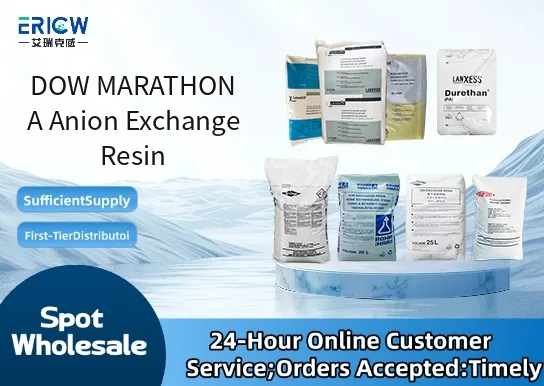
Highly uniform spherical beads for consistent hydraulic performance and low pressure drop.
Strong-base Type I functional groups (quaternary ammonium) for efficient removal of weakly ionized acids including silica and boron.
Excellent chemical and thermal stability, enabling reliable operation in demanding regeneration cycles.
Optimized for high capacity and selectivity in demineralization systems requiring ultrapure water.
Low total organic carbon (TOC) extractables, minimizing contamination risk in critical power and semiconductor applications.
Polishing anion exchange in high-purity water systems for power generation boilers.
Final polishing step in ultrapure water (UPW) production for semiconductor manufacturing.
Removal of silica and trace anions in pharmaceutical-grade purified water systems.
Industrial demineralization for process water in electronics and fine chemical synthesis.
Regenerable anion exchange component in mixed-bed and separate-bed deionization units.
| Chemical Type | Strong-base anion exchange resin, Type I quaternary ammonium |
| Product Form | Moist, spherical beads (Na⁺ form) |
| Appearance | Amber, translucent, uniform beads |
| Functional Group | –N(CH₃)₃Cl⁻ |
| Ion Exchange Capacity (min) | 1.2 eq/L (dry basis) |
| Moisture Content | 47–53% (as shipped) |
| Particle Size Range | 0.3–1.2 mm (95% retained on 16 mesh, passes 50 mesh) |
| Uniformity Coefficient (max) | 1.6 |
Q1: What is the primary functional group and base type of DOW MARATHON A resin?
A: DOW MARATHON A is a strongly basic anion exchange resin with quaternary ammonium functional groups (Type I), featuring a polystyrene-divinylbenzene matrix and designed for efficient removal of strong and weak acids in deionization applications.
Q2: How does DOW MARATHON A differ from weak-base anion resins in terms of regeneration and capacity?
A: Unlike weak-base resins, DOW MARATHON A can be regenerated with caustic soda (NaOH) and retains high total capacity across a wide pH range, including neutral and acidic conditions. It effectively removes silica and CO₂-derived alkalinity—making it suitable for polishing service in mixed-bed or two-bed demineralization systems.
Q3: Is DOW MARATHON A suitable for use in high-purity water systems, such as those for pharmaceutical or microelectronics applications?
A: Yes—DOW MARATHON A is commonly employed in high-purity water production when configured in mixed-bed or layered-bed configurations. Its low leachable organics and consistent physical stability support stringent conductivity and silica specifications required in these sensitive applications.
Q4: What are key operational considerations during startup and service cycles?
A: Proper bed conditioning—including thorough backwashing, uniform resin settling, and controlled initial rinse—is essential to ensure optimal hydraulic distribution and minimize channeling. Avoid exposure to oxidizing agents (e.g., chlorine, ozone) and high-temperature feedwater beyond manufacturer-recommended limits to preserve resin integrity and longevity.
Contact With Us:
E-mail: wangxingqiang@ericwchem.com
Have a Questions? Call Us:
Add:
Building A1, Jiete Industrial Park, Huangpu District, Guangzhou City, Guangdong Province, China