English
 Español
 tiếng việt
 русский
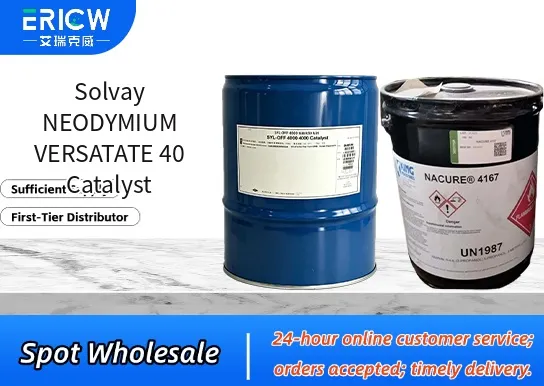
Highly active neodymium-based catalyst optimized for stereospecific diene polymerization.
Soluble in common hydrocarbon solvents, enabling homogeneous catalysis and precise reaction control.
Excellent thermal stability under industrial polymerization conditions (up to 80 °C).
Low volatility and minimal metal residue in final polymer products.
Consistent batch-to-batch performance supported by Solvay’s stringent quality assurance protocols.
Production of high-cis polybutadiene rubber (BR) for tire treads and sidewalls.
Catalysis in solution polymerization of isoprene to synthetic cis-1,4-polyisoprene.
Co-catalyzed systems for selective copolymerization of butadiene with styrene or acrylonitrile.
Manufacture of specialty elastomers requiring superior resilience and low hysteresis.
| Chemical Type | Neodymium carboxylate complex (versatate ligand) |
| Product Form | Liquid solution in aromatic hydrocarbon solvent |
| Appearance | Clear, amber to reddish-brown liquid |
| Neodymium Content (as Nd) | Approx. 4.0 wt% (equivalent to 40% active metal complex) |
| Density (20 °C) | 0.92–0.96 g/cm³ |
| Viscosity (25 °C) | 30–60 cP |
| Storage Stability | Stable for ≥12 months at 5–25 °C under inert atmosphere |
| Primary Applications | Stereoselective diene polymerization catalyst |
Q1: What is the primary function of Solvay NEODYMIUM VERSATATE 40 in synthetic rubber production?
A: It serves as a highly active neodymium-based catalyst for the stereospecific polymerization of diene monomers—particularly in the production of high-cis polybutadiene (Nd-PBR) and neodymium-based polyisoprene—enabling excellent molecular weight control and superior elastomeric properties.
Q2: How is Solvay NEODYMIUM VERSATATE 40 typically supplied and handled?
A: It is supplied as a stable, viscous liquid solution containing ~40 wt% neodymium versatate in a hydrocarbon solvent blend. The product is air- and moisture-sensitive and should be stored under inert atmosphere (e.g., nitrogen or argon), at controlled ambient temperatures, and handled using standard organometallic safety protocols.
Q3: What are key advantages of using this catalyst over traditional cobalt or nickel systems?
A: Solvay NEODYMIUM VERSATATE 40 delivers higher cis-1,4 selectivity, narrower molecular weight distribution, improved process stability, and enhanced green strength in raw rubber—contributing to better tire tread performance, lower hysteresis, and improved fatigue resistance compared with legacy transition metal catalysts.
Q4: Is Solvay NEODYMIUM VERSATATE 40 compatible with common co-catalysts used in Nd-based polymerization?
A: Yes—it is designed for use with standard alkylaluminum co-catalysts (e.g., triethylaluminum or diethylaluminum chloride) and optional electron donors, allowing flexible formulation tuning to achieve target polymer architecture and kinetics.
Q5: What safety considerations apply during industrial-scale handling?
A: As an organometallic compound, it reacts exothermically with water and may ignite upon contact with moist air. Handling requires engineering controls (inerted transfer systems, closed-loop dosing), personal protective equipment (chemical-resistant gloves, face shield), and strict adherence to site-specific SOPs for pyrophoric materials.
Contact With Us:
E-mail: wangxingqiang@ericwchem.com
Have a Questions? Call Us:
Add:
Building A1, Jiete Industrial Park, Huangpu District, Guangzhou City, Guangdong Province, China