English
 Español
 tiếng việt
 русский
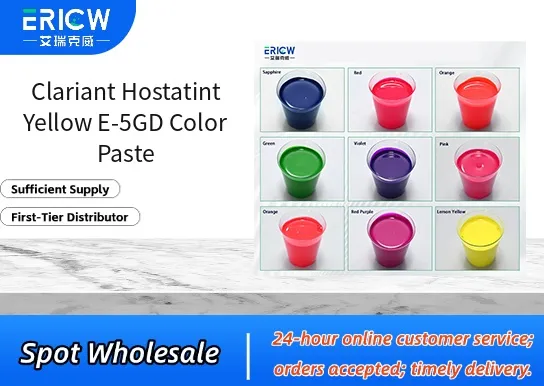
High chroma yellow shade with excellent lightfastness and thermal stability for demanding processing conditions.
Optimized for compatibility with polyolefins, including PP and HDPE, enabling uniform dispersion without agglomeration.
Low migration formulation suitable for food-contact compliant applications when used within regulatory limits.
Ready-to-use liquid paste format ensures easy handling, precise dosing, and reduced dust exposure during processing.
REACH-compliant and free of heavy metals, azo dyes, and restricted substances per Clariant’s Responsible Care standards.
Polypropylene (PP) fibers and nonwovens for hygiene and medical products.
HDPE and LDPE packaging films requiring vibrant, stable yellow coloration.
Injection-molded consumer goods such as containers, toys, and household items.
Blown and extruded profiles in automotive interior components.
Masterbatch production for general-purpose thermoplastic coloring.
| Chemical Type | Organic pigment dispersion in carrier medium |
| Product Form | Liquid color paste |
| Appearance | Homogeneous, viscous yellow liquid |
| Primary Applications | Polyolefins (PP, PE), masterbatch, fiber & film coloring |
| Key Features | High dispersion stability, low viscosity, excellent batch-to-batch consistency |
| Benefits | Reduced processing time, minimal filter pressure build-up, consistent color strength |
| Storage Conditions | Store at 10–30 °C; protect from freezing and direct sunlight |
| Regulatory Compliance | Complies with EU Directive 2002/72/EC for food-contact plastics (when used within specified limits) |
Q1: What is the primary application area for Hostatint Yellow E-5GD Color Paste?
A: Hostatint Yellow E-5GD is a high-performance organic pigment dispersion designed primarily for coloration of polyolefin compounds—especially injection-molded and extruded PP and HDPE parts—where excellent heat stability, lightfastness, and dispersion quality are required.
Q2: Is this color paste suitable for food-contact applications?
A: Hostatint Yellow E-5GD is formulated to meet general regulatory expectations for indirect food contact in plastics, subject to compliance with applicable regional requirements. Final approval depends on the complete formulation, processing conditions, and end-use compliance testing by the compounder or converter.
Q3: How should this paste be incorporated into polymer melts?
A: It is typically added directly to the polymer melt via gravimetric or volumetric dosing systems during compounding or masterbatch production. Good mixing efficiency and sufficient residence time ensure optimal dispersion without pigment agglomeration.
Q4: What is the typical dosage range when using this paste in polyolefins?
A: Dosage depends on the desired shade intensity and base polymer characteristics, but it is generally used at low concentrations—typically ranging from 0.1% to 2% by weight relative to the final compound.
Q5: Does this product require special storage or handling precautions?
A: Store in original sealed containers at temperatures between 5 °C and 30 °C, away from direct sunlight and sources of heat. Avoid freezing, and ensure adequate ventilation during handling to minimize dust exposure. Refer to the Safety Data Sheet for detailed occupational hygiene guidance.
Contact With Us:
E-mail: wangxingqiang@ericwchem.com
Have a Questions? Call Us:
Add:
Building A1, Jiete Industrial Park, Huangpu District, Guangzhou City, Guangdong Province, China